Advertisements
Advertisements
प्रश्न
When the non-parallel sides of a trapezium are equal then it is known as
पर्याय
a square
a rectangle
an isosceles trapezium
a parallelogram
Advertisements
उत्तर
When the non-parallel sides of a trapezium are equal then it is known as an isosceles trapezium
APPEARS IN
संबंधित प्रश्न
Find the area, in square metres, of the trapezium whose bases and altitude is as under:
bases = 12 dm and 20 dm, altitude = 10 dm
The area of a trapezium is 960 cm2. If the parallel sides are 34 cm and 46 cm, find the distance between them.
Find the area of a trapezium whose parallel sides are 25 cm, 13 cm and the other sides are 15 cm each.
If the area of a trapezium is 28 cm2 and one of its parallel sides is 6 cm, find the other parallel side if its altitude is 4 cm.
Find the area of the field shown in Fig. 20.39 by dividing it into a square, a rectangle and a trapezium.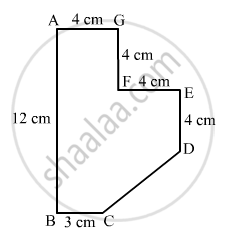
Find the missing values.
| Height 'h' | Parallel side 'a` | Parallel side 'b` | Area |
| 19 m | 16 m | 323 sq.m |
The sunshade of a window is in the form of isosceles trapezium whose parallel sides are 81 cm and 64 cm and the distance between them is 6 cm. Find the cost of painting the surface at the rate of ₹ 2 per sq.cm
The area of the trapezium, if the parallel sides are measuring 8 cm and 10 cm and the height 5 cm is
The table top is in the shape of a trapezium with measurements given in the figure. Find the cost of the glass used to cover the table at the rate of ₹ 6 per 10 sq.cm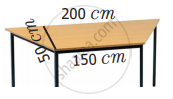
The area of a trapezium become 4 times if its height gets doubled.
