Advertisements
Advertisements
प्रश्न
Find the area, in square metres, of the trapezium whose bases and altitude is as under:
bases = 12 dm and 20 dm, altitude = 10 dm
Advertisements
उत्तर
Given:
Bases:
\[12 dm =\frac{12}{10}m = 1.2 m\]
And, 20 dm \[=\frac{20}{10}m=2 m\]
Altitude = 10 dm \[=\frac{10}{10}m = 1 m\]
Area of trapezium \[=\frac{1}{2}\] x (Sum of the bases) x (Altitude)
\[ = \frac{1}{2} \times (1 . 2 + 2) m \times (1) m\]
\[ = 1 . 6 \times m\times m\]
\[ {=1.6 m}^2 \]
संबंधित प्रश्न
Find the area of a trapezium whose parallel sides are of length 16 dm and 22 dm and whose height is 12 dm.
Find the area of Fig. as the sum of the areas of two trapezium and a rectangle.
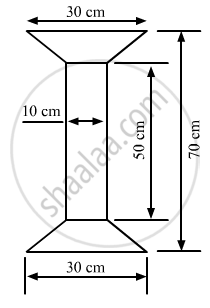
The area of a trapezium is 91 cm2 and its height is 7 cm. If one of the parallel sides is longer than the other by 8 cm, find the two parallel sides.
The parallel sides of a trapezium are 25 cm and 13 cm; its nonparallel sides are equal, each being 10 cm, find the area of the trapezium.
Find the area of a trapezium whose parallel sides are 25 cm, 13 cm and the other sides are 15 cm each.
In Fig. 20.38, a parallelogram is drawn in a trapezium, the area of the parallelogram is 80 cm2, find the area of the trapezium.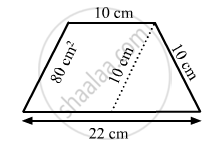
The parallel sides of a trapezium are in ratio 3: 4. If the distance between the parallel sides is 9 dm and its area is 126 dm2; find the lengths of its parallel sides.
Find the missing values.
| Height 'h' | Parallel side 'a` | Parallel side 'b` | Area |
| 16 cm | 15 cm | 360 sq.cm |
The area of a trapezium is 180 sq.cm and its height is 9 cm. If one of the parallel sides is longer than the other by 6 cm. Find the length of the parallel sides.
The areas of two circles are in the ratio 49 : 64. Find the ratio of their circumferences.
