Advertisements
Advertisements
प्रश्न
The areas of two circles are in the ratio 49 : 64. Find the ratio of their circumferences.
Advertisements
उत्तर
Given, the area of two circles are in the ratio 49 : 64
Area of a circle = πr2
Let area of the first circle = `pir_1^2`
And area of the second circle = `pir_2^2`
According to the question,
`49/64 = (pir_1^2)/(pir_2^2)`
⇒ `49/64 = r_1^2/r_2^2`
⇒ `(7)^2/(8)^2 = r_1^2/r_2^2`
⇒ `(7/8)^2 = (r_1/r_2)^2`
∴ r1 = 7 and r2 = 8
The ratio of circumferences of these two circles
= `(2pir_1)/(2pir_2)` ...[∵ Circumference of circle = 2πr]
= `r_1/r_2`
= `7/8`
Hence, required ratio is 7 : 8
APPEARS IN
संबंधित प्रश्न
Find the area, in square metres, of the trapezium whose bases and altitude is as under:
bases = 12 dm and 20 dm, altitude = 10 dm
Find the area, in square metres, of the trapezium whose bases and altitude is as under:
bases = 8 m and 60 dm, altitude = 40 dm
Find the altitude of a trapezium whose area is 65 cm2 and whose bases are 13 cm and 26 cm.
Find the area of a trapezium whose parallel sides of lengths 10 cm and 15 cm are at a distance of 6 cm from each other. Calculate this area as
the sum of the areas of two triangles and one rectangle.
The cross-section of a canal is a trapezium in shape. If the canal is 10 m wide at the top 6 m wide at the bottom and the area of cross-section is 72 m2 determine its depth.
There is a pentagonal shaped park as shown in Fig. 20.50. Jyoti and Kavita divided it in two different ways.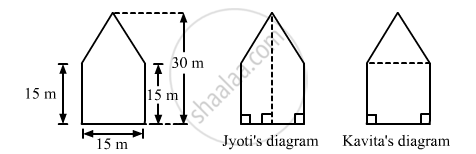
Find the area of this park using both ways. Can you suggest some another way of finding its areas?
Find the missing values.
| Height 'h' | Parallel side 'a` | Parallel side 'b` | Area |
| 10 m | 12 m | 20 m |
The area of a trapezium is 180 sq.cm and its height is 9 cm. If one of the parallel sides is longer than the other by 6 cm. Find the length of the parallel sides.
The perimeter of a trapezium is 52 cm and its each non-parallel side is equal to 10 cm with its height 8 cm. Its area is ______.
A trapezium with 3 equal sides and one side double the equal side can be divided into ______ equilateral triangles of ______ area.
