Advertisements
Advertisements
प्रश्न
The area of a trapezium is 180 sq.cm and its height is 9 cm. If one of the parallel sides is longer than the other by 6 cm. Find the length of the parallel sides.
Advertisements
उत्तर
Let one of the parallel side be ‘a’ cm.
Given one parallel sides is longer than the other by 6 cm.
i.e. b = a + 6 cm
Also given height ‘h’ = 9 cm
Area of trapezium = 180 sq.cm
`1/2 xx "h" xx ("a" + "b")` = 180 cm2
`1/2 xx 9 xx ("a" + "a" + 6)` = 180
`1/2 xx 9 xx (2"a" + 6)` = 180
2a + 6 = `(180 xx 2)/9`
= 20 × 2
2a + 6 = 40
2a = 40 – 6
= 34
a = `34/2`
= 17 cm
b = a + 6
= 17 + 6
= 23 cm
∴ The parallel sides are a = 17 cm and b = 23 cm
APPEARS IN
संबंधित प्रश्न
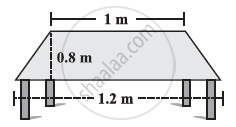
The shape of the top surface of a table is a trapezium. Find its area if its parallel sides are 1 m and 1.2 m and perpendicular distance between them is 0.8 m.
Find the area, in square metres, of the trapezium whose bases and altitude is as under:
bases = 8 m and 60 dm, altitude = 40 dm
The area of a trapezium is 91 cm2 and its height is 7 cm. If one of the parallel sides is longer than the other by 8 cm, find the two parallel sides.
Mohan wants to buy a trapezium shaped field. Its side along the river is parallel and twice the side along the road. If the area of this field is 10500 m2 and the perpendicular distance between the two parallel sides is 100 m, find the length of the side along the river.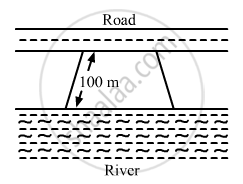
The parallel sides of a trapezium are 25 cm and 13 cm; its nonparallel sides are equal, each being 10 cm, find the area of the trapezium.
Find the area of the pentagon shown in fig. 20.48, if AD = 10 cm, AG = 8 cm, AH = 6 cm, AF = 5 cm, BF = 5 cm, CG = 7 cm and EH = 3 cm.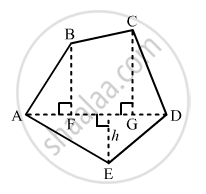
The parallel sides of a trapezium are in ratio 3: 4. If the distance between the parallel sides is 9 dm and its area is 126 dm2; find the lengths of its parallel sides.
Find the missing values.
| Height 'h' | Parallel side 'a` | Parallel side 'b` | Area |
| 19 m | 16 m | 323 sq.m |
The perimeter of a trapezium is 52 cm and its each non-parallel side is equal to 10 cm with its height 8 cm. Its area is ______.
The area of a trapezium with equal non-parallel sides is 168 m2. If the lengths of the parallel sides are 36 m and 20 m, find the length of the non-parallel sides.
