Advertisements
Advertisements
प्रश्न
Find the altitude of a trapezium whose area is 65 cm2 and whose bases are 13 cm and 26 cm.
Advertisements
उत्तर
Given:
Area of the trapezium=65 cm2
The lengths of the opposite parallel sides are 13 cm and 26 cm.
Area of trapezium\[=\frac{1}{2}\times(\text{ Sum of parallel bases })\times(\text{ Altitude })\]
On putting the values:
\[65 = \frac{1}{2} \times (13 + 26) \times (\text{ Altitude })\]
\[65 \times 2 = 39 \times\text{ Altitude }\]
\[\text{ Altitude }=\frac{130}{39}=\frac{10}{3}cm\]
संबंधित प्रश्न
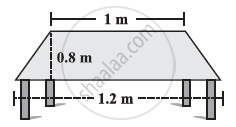
The shape of the top surface of a table is a trapezium. Find its area if its parallel sides are 1 m and 1.2 m and perpendicular distance between them is 0.8 m.
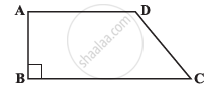
Length of the fence of a trapezium shaped field ABCD is 120 m. If BC = 48 m, CD = 17 m and AD = 40 m, find the area of this field. Side AB is perpendicular to the parallel sides AD and BC.
Find the area of trapezium with base 15 cm and height 8 cm, if the side parallel to the given base is 9 cm long.
Top surface of a table is trapezium in shape. Find its area if its parallel sides are 1 m and 1.2 m and perpendicular distance between them is 0.8 m.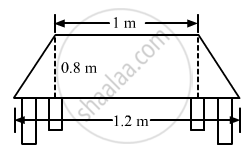
The cross-section of a canal is a trapezium in shape. If the canal is 10 m wide at the top 6 m wide at the bottom and the area of cross-section is 72 m2 determine its depth.
The parallel sides of a trapezium are in ratio 3: 4. If the distance between the parallel sides is 9 dm and its area is 126 dm2; find the lengths of its parallel sides.
Find the area of the trapezium ABCD in which AB || DC, AB = 18 cm, ∠B = ∠C = 90°, CD = 12 cm and AD = 10 cm.
The area of a trapezium is 1080 sq.cm. If the lengths of its parallel sides are 55.6 cm and 34.4 cm. Find the distance between them
The area of a trapezium is 180 sq.cm and its height is 9 cm. If one of the parallel sides is longer than the other by 6 cm. Find the length of the parallel sides.
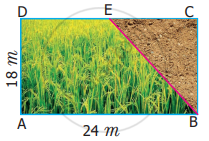
Arivu has a land ABCD with the measurements given in the figure. If a portion ABED is used for cultivation (where E is the mid-point of DC), find the cultivated area.