Advertisements
Advertisements
प्रश्न
Find the area enclosed by each of the following figures [Fig. 20.49 (i)-(iii)] as the sum of the areas of a rectangle and a trapezium: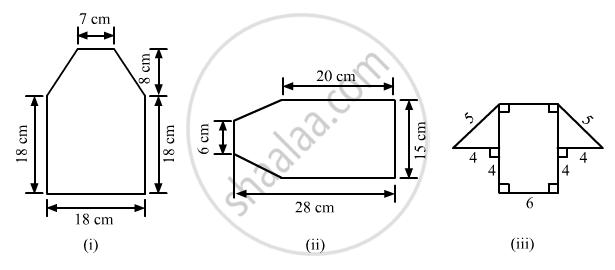
Advertisements
उत्तर
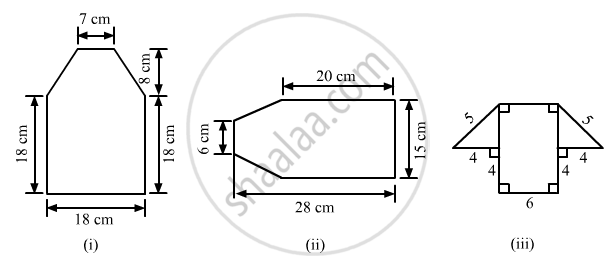 \[(i)\]
The given figure can be divided into a rectangle and a trapezium as shown below:
From the above firgure:
Area of the complete figure = (Area of square ABCF)+(Area of trapezium CDEF)
\[=(AB\times BC)+[\frac{1}{2}\times(FC+ED)\times(\text{ Distance between FC and ED })]\]
\[=(18\times18)+[\frac{1}{2}\times(18+7)\times(8)]\]
\[=324+100\]
\[ {=424 cm}^2\]
\[(ii)\]
The given figure can be divided in the following manner:\]
From the above figure:
AB = AC-BC=28-20=8 cm
So that area of the complete figure = (area of rectangle BCDE)+(area of trapezium ABEF)
\[=(BC\times CD)+[\frac{1}{2}\times(BE+AF)\times(AB)]\]
\[=(20\times15)+[\frac{1}{2}\times(15+6)\times(8)]\]
\[=300+84\]
\[ {=384 cm}^2\]
The given figure can be divided in the following manner:
From the above figure:
EF = AB = 6 cm
Now, using the Pythagoras theorem in the right angle triangle CDE:
\[ 5^2 {= 4}^2 {+CE}^2 \]
\[ {CE}^2 = 25-16=9\]
\[CE =\sqrt{9}= 3 cm\]
\[\text{ And, }GD=GH+HC+CD=4+6+4=14 cm\]
\[ \therefore\text{ Area of the complete figure }= (\text{ Area of rectangle ABCH })+(\text{ Area of trapezium GDEF })\]
\[=(AB\times BC)+[\frac{1}{2}\times(GD+EF)\times(CE)]\]
\[=(6\times4)+[\frac{1}{2}\times(14+6)\times(3)]\]
\[=24+30\]
\[ {=54 cm}^2\]
संबंधित प्रश्न
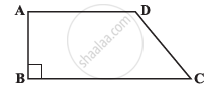
Length of the fence of a trapezium shaped field ABCD is 120 m. If BC = 48 m, CD = 17 m and AD = 40 m, find the area of this field. Side AB is perpendicular to the parallel sides AD and BC.
Find the area, in square metres, of the trapezium whose bases and altitude is as under:
bases = 28 cm and 3 dm, altitude = 25 cm
Find the area, in square metres, of the trapezium whose bases and altitude is as under:
bases = 8 m and 60 dm, altitude = 40 dm
The area of a trapezium is 960 cm2. If the parallel sides are 34 cm and 46 cm, find the distance between them.
The cross-section of a canal is a trapezium in shape. If the canal is 10 m wide at the top 6 m wide at the bottom and the area of cross-section is 72 m2 determine its depth.
If the area of a trapezium is 28 cm2 and one of its parallel sides is 6 cm, find the other parallel side if its altitude is 4 cm.
Find the area of the pentagon shown in fig. 20.48, if AD = 10 cm, AG = 8 cm, AH = 6 cm, AF = 5 cm, BF = 5 cm, CG = 7 cm and EH = 3 cm.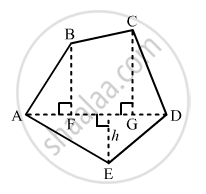
The area of a trapezium is 1586 sq.cm. The distance between its parallel sides is 26 cm. If one of the parallel sides is 84 cm then find the other side
A trapezium with 3 equal sides and one side double the equal side can be divided into ______ equilateral triangles of ______ area.
The area of a trapezium with equal non-parallel sides is 168 m2. If the lengths of the parallel sides are 36 m and 20 m, find the length of the non-parallel sides.
