Advertisements
Advertisements
प्रश्न
The area of a trapezium with equal non-parallel sides is 168 m2. If the lengths of the parallel sides are 36 m and 20 m, find the length of the non-parallel sides.
Advertisements
उत्तर
Length of the parallel sides are 36 m and 20 m.
Area of a trapezium = 168 m2
∵ Area of a trapezium = `1/2 xx ["Sum af parallel sides"] xx "Height"`
∴ `168 = 1/2 xx [36 + 20] xx "Height"`
⇒ Height = `(168 xx 2)/56 = 336/56` = 6 m
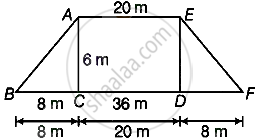
In ΔACB, using Pythagoras theorem,
(AB)2 = (BC)2 + (AC)2
⇒ (AB)2 = (8)2 + (6)2
⇒ (AB)2 = 64 + 36
⇒ (AB)2 = 100
∴ AB = `sqrt(100)` = 10 m
Hence, length of the non-parallel side is 10 m.
APPEARS IN
संबंधित प्रश्न
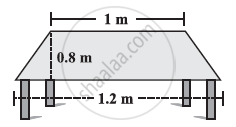
The shape of the top surface of a table is a trapezium. Find its area if its parallel sides are 1 m and 1.2 m and perpendicular distance between them is 0.8 m.
Find the area of the field shown in Fig. 20.39 by dividing it into a square, a rectangle and a trapezium.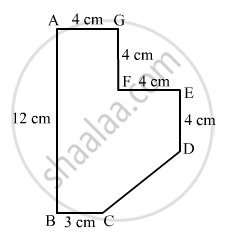
☐ PQRS is an isosceles trapezium l(PQ) = 7 cm. seg PM ⊥ seg SR, l(SM) = 3 cm, Distance between two parallel sides is 4 cm, find the area of ☐ PQRS.

The two parallel sides and the distance between them are in the ratio 3: 4: 2. If the area of the trapezium is 175 cm2, find its height.
The area of a trapezium is 279 sq.cm and the distance between its two parallel sides is 18 cm. If one of its parallel sides is longer than the other side by 5 cm, find the lengths of its parallel sides.
Find the missing values.
| Height 'h' | Parallel side 'a` | Parallel side 'b` | Area |
| 10 m | 12 m | 20 m |
Find the missing values.
| Height 'h' | Parallel side 'a` | Parallel side 'b` | Area |
| 16 cm | 15 cm | 360 sq.cm |
The sunshade of a window is in the form of isosceles trapezium whose parallel sides are 81 cm and 64 cm and the distance between them is 6 cm. Find the cost of painting the surface at the rate of ₹ 2 per sq.cm
Find the area of the following fields. All dimensions are in metres.

Find the area of the following fields. All dimensions are in metres.

