Advertisements
Advertisements
Question
The area of a trapezium with equal non-parallel sides is 168 m2. If the lengths of the parallel sides are 36 m and 20 m, find the length of the non-parallel sides.
Advertisements
Solution
Length of the parallel sides are 36 m and 20 m.
Area of a trapezium = 168 m2
∵ Area of a trapezium = `1/2 xx ["Sum af parallel sides"] xx "Height"`
∴ `168 = 1/2 xx [36 + 20] xx "Height"`
⇒ Height = `(168 xx 2)/56 = 336/56` = 6 m
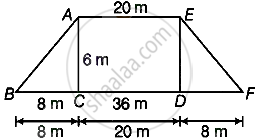
In ΔACB, using Pythagoras theorem,
(AB)2 = (BC)2 + (AC)2
⇒ (AB)2 = (8)2 + (6)2
⇒ (AB)2 = 64 + 36
⇒ (AB)2 = 100
∴ AB = `sqrt(100)` = 10 m
Hence, length of the non-parallel side is 10 m.
APPEARS IN
RELATED QUESTIONS
Find the area, in square metres, of the trapezium whose bases and altitude is as under:
bases = 28 cm and 3 dm, altitude = 25 cm
Find the area, in square metres, of the trapezium whose bases and altitude is as under:
bases = 8 m and 60 dm, altitude = 40 dm
Find the area of a trapezium whose parallel sides of lengths 10 cm and 15 cm are at a distance of 6 cm from each other. Calculate this area as the difference of the area of a rectangle and the sum of the areas of two triangles.
The cross-section of a canal is a trapezium in shape. If the canal is 10 m wide at the top 6 m wide at the bottom and the area of cross-section is 72 m2 determine its depth.
Find the area of a trapezium whose parallel sides are 25 cm, 13 cm and the other sides are 15 cm each.
If the area of a trapezium is 28 cm2 and one of its parallel sides is 6 cm, find the other parallel side if its altitude is 4 cm.
The area of a trapezium is 1586 sq.cm. The distance between its parallel sides is 26 cm. If one of the parallel sides is 84 cm then find the other side
The area of the trapezium, if the parallel sides are measuring 8 cm and 10 cm and the height 5 cm is
The area of a trapezium become 4 times if its height gets doubled.
Find the area of the following fields. All dimensions are in metres.

