Advertisements
Advertisements
Question
Mukesh walks around a circular track of radius 14 m with a speed of 4 km/hr. If he takes 20 rounds of the track, for how long does he walk?
Advertisements
Solution
Radius of the circular track = 14 m
Circumference of the circular track = 2πr
= `2 xx 22/7 xx 14`
= 44 × 2
= 88 m
Total distance cover in 20 rounds = 88 × 20 = 1760 m
Speed of Mukesh on the circular track = 4 km/h
= `(4 xx 1000)/60`
= `(2 xx 100)/3`
= `200/3` m/min
Time taken by Mukesh = `1760/(200/3)`
= `(1760 xx 3)/200`
= `(176 xx 3)/20`
= 26.4 min
26.4 min = 26 min and 24 s
APPEARS IN
RELATED QUESTIONS
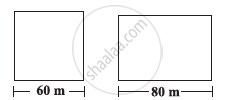
A square and a rectangular field with measurements as given in the figure have the same perimeter. Which field has a larger area?
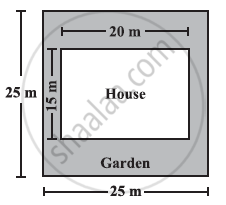
Mrs. Kaushik has a square plot with the measurement as shown in the following figure. She wants to construct a house in the middle of the plot. A garden is developed around the house. Find the total cost of developing a garden around the house at the rate of Rs 55 per m2.
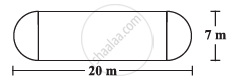
The shape of a garden is rectangular in the middle and semi circular at the ends as shown in the diagram. Find the area and the perimeter of the garden [Length of rectangle is 20 − (3.5 + 3.5) metres]
A playground has the shape of a rectangle, with two semi-circles on its smaller sides as diameters, added to its outside. If the sides of the rectangle are 36 m and 24.5 m, find the area of the playground. (Take π = 22/7).
The length and breadth of a rectangular field are in the ratio 7 : 4. If its perimeter is 440 m, find its length and breadth. Also, find the cost of fencing it @ ₹150 per m.
The length and breadth of the rectangular piece of land area in the ratio of 5 : 3. If the total cost of fencing it at the rate of ₹48 per metre is ₹19,200, find its length and breadth.
The area of a parallelogram is 60 cm2 and one of its altitudes is 5 cm. The length of its corresponding side is ______.
The perimeter of a rectangle becomes ______ times its original perimeter, if its length and breadth are doubled.
The length of an aluminium strip is 40 cm. If the lengths in cm are measured in natural numbers, write the measurement of all the possible rectangular frames which can be made out of it. (For example, a rectangular frame with 15 cm length and 5 cm breadth can be made from this strip.)
Which branch of mathematics deals with the measurement of length, area, volume, and surface area of geometric figures?
