Advertisements
Advertisements
Question
In a trapezium if the sum of the parallel sides is 10 cm and the area is 140 sq.cm, then the height is
Options
7 cm
40 cm
14 cm
28 cm
Advertisements
Solution
28 cm
Explanation;
Hint:
Area = `1/2` × h × (a + b)
140 = `1/2` × h × 10
h = `(140 xx 2)/10`
⇒ h = 28
APPEARS IN
RELATED QUESTIONS
Find the area of a trapezium whose parallel sides are of length 16 dm and 22 dm and whose height is 12 dm.
Find the altitude of a trapezium whose area is 65 cm2 and whose bases are 13 cm and 26 cm.
Find the area of a trapezium whose parallel sides of lengths 10 cm and 15 cm are at a distance of 6 cm from each other. Calculate this area as the difference of the area of a rectangle and the sum of the areas of two triangles.
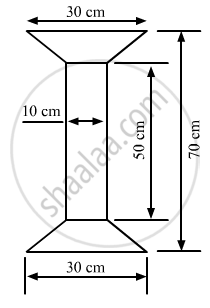
Find the area of Fig. as the sum of the areas of two trapezium and a rectangle.
The area of a trapezium is 91 cm2 and its height is 7 cm. If one of the parallel sides is longer than the other by 8 cm, find the two parallel sides.
Find the area of the pentagon shown in fig. 20.48, if AD = 10 cm, AG = 8 cm, AH = 6 cm, AF = 5 cm, BF = 5 cm, CG = 7 cm and EH = 3 cm.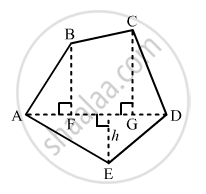
Find the missing values.
| Height 'h' | Parallel side 'a` | Parallel side 'b` | Area |
| 19 m | 16 m | 323 sq.m |
The area of a trapezium is 1080 sq.cm. If the lengths of its parallel sides are 55.6 cm and 34.4 cm. Find the distance between them
Find the area of the following fields. All dimensions are in metres.

Find the area of the shaded portion in the following figure.

