Advertisements
Advertisements
प्रश्न
Find the area of the following fields. All dimensions are in metres.

Advertisements
उत्तर
Area of the given figure
= Area of ΔEFH + Area of rectangle EDCI + Area of trapezium FHJG + Area of trapezium ICBK + Area of ΔGJA + Area of ΔKBA
Area of ΔEFH = `1/2 xx "Base" xx "Height"`
= `1/2 xx 40 xx 80`
= 40 × 40
= 1600 m2
Area of rectangle EDCI = Length × Breadth = 100 × 160 = 16000 m2
Area of trapezium FHJG = `1/2` × [Sum of parallel sides] × Height
= `1/2 xx [40 + 160] xx 160`
= `200/2 xx 160`
= 100 × 160
= 16000 m2
Area of trapezium ICBK = `1/2` × [Sum of parallel sides] × Height
= `1/2 xx [60 + 100] xx 120`
= `1/2 xx 160 xx 120`
= 80 × 120
= 9600 m2
Area of ΔAJG = `1/2` × Base × Height
= `1/2 xx 160 xx 100`
= 80 × 100
= 8000 m2
Area of ΔKBA = `1/2` × Base × Height
= `1/2 xx 60 xx 60`
= 60 × 30
= 1800 m2
Thus, the area of the complete figure
= 1600 + 16000 + 16000 + 9600 + 8000 + 1800
= 53000 m2
APPEARS IN
संबंधित प्रश्न
Find the altitude of a trapezium whose area is 65 cm2 and whose bases are 13 cm and 26 cm.
Find the sum of the lengths of the bases of a trapezium whose area is 4.2 m2 and whose height is 280 cm.
Find the area of a trapezium whose parallel sides of lengths 10 cm and 15 cm are at a distance of 6 cm from each other. Calculate this area as
the sum of the areas of two triangles and one rectangle.
Top surface of a table is trapezium in shape. Find its area if its parallel sides are 1 m and 1.2 m and perpendicular distance between them is 0.8 m.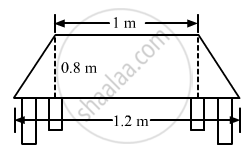
If the area of a trapezium is 28 cm2 and one of its parallel sides is 6 cm, find the other parallel side if its altitude is 4 cm.
Find the area enclosed by each of the following figures [Fig. 20.49 (i)-(iii)] as the sum of the areas of a rectangle and a trapezium: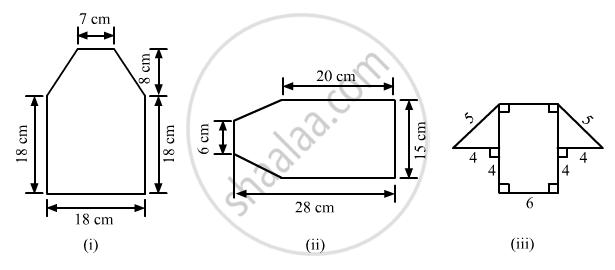
☐ PQRS is an isosceles trapezium l(PQ) = 7 cm. seg PM ⊥ seg SR, l(SM) = 3 cm, Distance between two parallel sides is 4 cm, find the area of ☐ PQRS.

The area of a trapezium is 279 sq.cm and the distance between its two parallel sides is 18 cm. If one of its parallel sides is longer than the other side by 5 cm, find the lengths of its parallel sides.
The table top is in the shape of a trapezium with measurements given in the figure. Find the cost of the glass used to cover the table at the rate of ₹ 6 per 10 sq.cm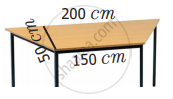
A trapezium with 3 equal sides and one side double the equal side can be divided into ______ equilateral triangles of ______ area.
