Advertisements
Advertisements
प्रश्न
Top surface of a table is trapezium in shape. Find its area if its parallel sides are 1 m and 1.2 m and perpendicular distance between them is 0.8 m.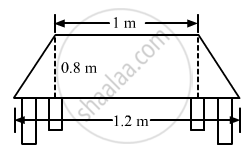
Advertisements
उत्तर
Lengths of the parallel sides are 1.2 m and 1 m and the perpendicular distance between them is 0.8 m.
∴ Area of the trapezium shaped surface \[=\frac{1}{2}\times(\text{ Sum of the parallel sides })\times(\text{ Perpendicular distance })\]
\[ = \frac{1}{2} \times (1 . 2 + 1) \times (0 . 8)\]
\[=\frac{1}{2}\times2.2\times0.8\]
\[ {=0.88 m}^2\]
संबंधित प्रश्न
Find the area of the field shown in Fig. 20.39 by dividing it into a square, a rectangle and a trapezium.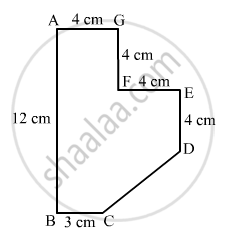
Find the missing values.
| Height 'h' | Parallel side 'a` | Parallel side 'b` | Area |
| 10 m | 12 m | 20 m |
Find the missing values.
| Height 'h' | Parallel side 'a` | Parallel side 'b` | Area |
| 19 m | 16 m | 323 sq.m |
The area of a trapezium is 1080 sq.cm. If the lengths of its parallel sides are 55.6 cm and 34.4 cm. Find the distance between them
In a trapezium if the sum of the parallel sides is 10 cm and the area is 140 sq.cm, then the height is
When the non-parallel sides of a trapezium are equal then it is known as
A trapezium with 3 equal sides and one side double the equal side can be divided into ______ equilateral triangles of ______ area.
The areas of two circles are in the ratio 49 : 64. Find the ratio of their circumferences.
Find the area of the following fields. All dimensions are in metres.

Find the area of the following fields. All dimensions are in metres.

