Advertisements
Advertisements
प्रश्न
Find the area, in square metres, of the trapezium whose bases and altitude is as under:
bases = 150 cm and 30 dm, altitude = 9 dm.
Advertisements
उत्तर
Given:
Bases:
\[150 cm =\frac{150}{100}m = 1.5 m\]
And, 30 dm \[=\frac{30}{10}m = 3 m\]
Altitude = 9 dm \[=\frac{9}{10}m = 0.9 m\]
Area of trapezium\[=\frac{1}{2}\times(\text{ Sum of the bases })\times(\text{ Altitude })\]
\[ = \frac{1}{2} \times (1 . 5 + 3) m \times (0 . 9) m\]
\[ = 2 . 025 \times m\times m\]
\[ {=2.025 m}^2 \]
संबंधित प्रश्न
Find the area, in square metres, of the trapezium whose bases and altitude is as under:
bases = 12 dm and 20 dm, altitude = 10 dm
Find the area of a trapezium whose parallel sides are of length 16 dm and 22 dm and whose height is 12 dm.
Find the altitude of a trapezium whose area is 65 cm2 and whose bases are 13 cm and 26 cm.
Mohan wants to buy a trapezium shaped field. Its side along the river is parallel and twice the side along the road. If the area of this field is 10500 m2 and the perpendicular distance between the two parallel sides is 100 m, find the length of the side along the river.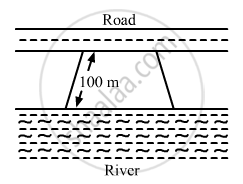
Find the area of the field shown in Fig. 20.39 by dividing it into a square, a rectangle and a trapezium.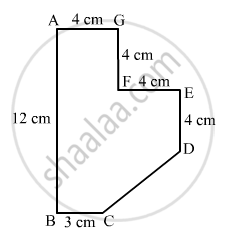
Find the area enclosed by each of the following figures [Fig. 20.49 (i)-(iii)] as the sum of the areas of a rectangle and a trapezium: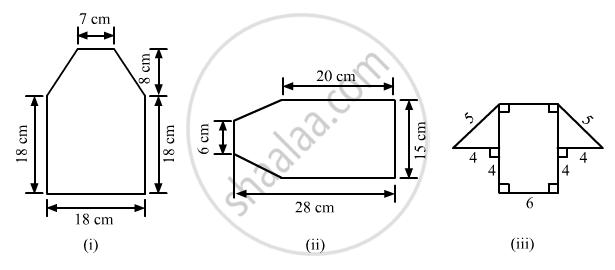
Find the missing values.
| Height 'h' | Parallel side 'a` | Parallel side 'b` | Area |
| 13 cm | 28 cm | 492 sq.cm |
The sunshade of a window is in the form of isosceles trapezium whose parallel sides are 81 cm and 64 cm and the distance between them is 6 cm. Find the cost of painting the surface at the rate of ₹ 2 per sq.cm
A trapezium with 3 equal sides and one side double the equal side can be divided into ______ equilateral triangles of ______ area.
The area of a trapezium become 4 times if its height gets doubled.
