Advertisements
Advertisements
प्रश्न
Find the missing values.
| Height 'h' | Parallel side 'a` | Parallel side 'b` | Area |
| 13 cm | 28 cm | 492 sq.cm |
Advertisements
उत्तर
Given the parallel sides a = 13 cm, 6 = 28 cm
Area of the trapezium = 492 sq.cm
`1/2` h(a + b) = 492
`1/2` × h × (13 + 28) = 492
h × 41 = 492 × 2
h = `(492 xx 2)/41`
h = 24 cm
Tabulating the results we get
| Height 'h' | Parallel side 'a` | Parallel side 'b` | Area |
| 24 cm | 13 cm | 28 cm | 492 sq.cm |
APPEARS IN
संबंधित प्रश्न
The area of a trapezium is 34 cm2 and the length of one of the parallel sides is 10 cm and its height is 4 cm. Find the length of the other parallel side.
Top surface of a raised platform is in the shape of a regular octagon as shown in the figure. Find the area of the octagonal surface.
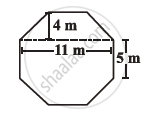
Find the area, in square metres, of the trapezium whose bases and altitude is as under:
bases = 8 m and 60 dm, altitude = 40 dm
Find the altitude of a trapezium whose area is 65 cm2 and whose bases are 13 cm and 26 cm.
The cross-section of a canal is a trapezium in shape. If the canal is 10 m wide at the top 6 m wide at the bottom and the area of cross-section is 72 m2 determine its depth.
The area of a trapezium is 91 cm2 and its height is 7 cm. If one of the parallel sides is longer than the other by 8 cm, find the two parallel sides.
The area of a trapezium is 384 cm2. Its parallel sides are in the ratio 3 : 5 and the perpendicular distance between them is 12 cm. Find the length of each one of the parallel sides.
Find the area enclosed by each of the following figures [Fig. 20.49 (i)-(iii)] as the sum of the areas of a rectangle and a trapezium: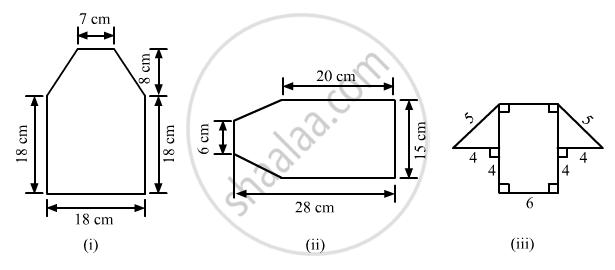
When the non-parallel sides of a trapezium are equal then it is known as
Find the area of the shaded portion in the following figure.

