Advertisements
Advertisements
प्रश्न
Find the missing values.
| Height 'h' | Parallel side 'a` | Parallel side 'b` | Area |
| 13 cm | 28 cm | 492 sq.cm |
Advertisements
उत्तर
Given the parallel sides a = 13 cm, 6 = 28 cm
Area of the trapezium = 492 sq.cm
`1/2` h(a + b) = 492
`1/2` × h × (13 + 28) = 492
h × 41 = 492 × 2
h = `(492 xx 2)/41`
h = 24 cm
Tabulating the results we get
| Height 'h' | Parallel side 'a` | Parallel side 'b` | Area |
| 24 cm | 13 cm | 28 cm | 492 sq.cm |
APPEARS IN
संबंधित प्रश्न
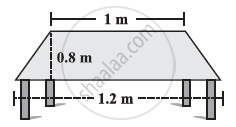
The shape of the top surface of a table is a trapezium. Find its area if its parallel sides are 1 m and 1.2 m and perpendicular distance between them is 0.8 m.
Find the height of a trapezium, the sum of the lengths of whose bases (parallel sides) is 60 cm and whose area is 600 cm2.
If the area of a trapezium is 28 cm2 and one of its parallel sides is 6 cm, find the other parallel side if its altitude is 4 cm.
The parallel sides of a trapezium are in ratio 3: 4. If the distance between the parallel sides is 9 dm and its area is 126 dm2; find the lengths of its parallel sides.
Find the area of the trapezium ABCD in which AB || DC, AB = 18 cm, ∠B = ∠C = 90°, CD = 12 cm and AD = 10 cm.
Find the missing values.
| Height 'h' | Parallel side 'a` | Parallel side 'b` | Area |
| 10 m | 12 m | 20 m |
Find the area of a trapezium whose parallel sides are 24 cm and 20 cm and the distance between them is 15 cm
A window is in the form of trapezium whose parallel sides are 105 cm and 50 cm respectively and the distance between the parallel sides is 60 cm. Find the cost of the glass used to cover the window at the rate of ₹ 15 per 100 sq.cm
In a trapezium if the sum of the parallel sides is 10 cm and the area is 140 sq.cm, then the height is
Find the area of the following fields. All dimensions are in metres.

