Advertisements
Advertisements
प्रश्न
The two parallel sides and the distance between them are in the ratio 3: 4: 2. If the area of the trapezium is 175 cm2, find its height.
Advertisements
उत्तर
Let the two parallel sides and the distance between them be 3x, 4x, 2x cm respectively
Area = `1/2` (sum of parallel sides) x (distance between parallel sides)
= `1/2` (3x + 4x) x 2x = 175 (given)
=> 7x x x = 175
=> 7x2 = 175
=> x2 = 25
=> x = 5
Height i.e. distance between parallel sides = 2x = 2 x 5 = 10 cm
APPEARS IN
संबंधित प्रश्न
The shape of the top surface of a table is a trapezium. Find its area if its parallel sides are 1 m and 1.2 m and perpendicular distance between them is 0.8 m.
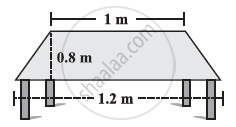
Find the sum of the lengths of the bases of a trapezium whose area is 4.2 m2 and whose height is 280 cm.
The area of a trapezium is 960 cm2. If the parallel sides are 34 cm and 46 cm, find the distance between them.
Top surface of a table is trapezium in shape. Find its area if its parallel sides are 1 m and 1.2 m and perpendicular distance between them is 0.8 m.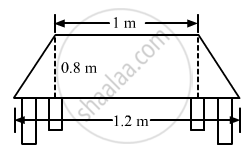
The cross-section of a canal is a trapezium in shape. If the canal is 10 m wide at the top 6 m wide at the bottom and the area of cross-section is 72 m2 determine its depth.
The area of a trapezium is 91 cm2 and its height is 7 cm. If one of the parallel sides is longer than the other by 8 cm, find the two parallel sides.
The parallel sides of a trapezium are 25 cm and 13 cm; its nonparallel sides are equal, each being 10 cm, find the area of the trapezium.
Find the area enclosed by each of the following figures [Fig. 20.49 (i)-(iii)] as the sum of the areas of a rectangle and a trapezium: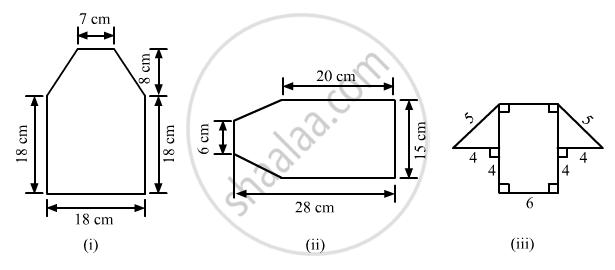
When the non-parallel sides of a trapezium are equal then it is known as
The area of a trapezium become 4 times if its height gets doubled.
