Advertisements
Advertisements
प्रश्न
The parallel sides of a trapezium are 25 cm and 13 cm; its nonparallel sides are equal, each being 10 cm, find the area of the trapezium.
Advertisements
उत्तर
Given:
The parallel sides of a trapezium are 25 cm and 13 cm.
Its nonparallel sides are equal in length and each is equal to 10 cm.
A rough sketch for the given trapezium is given below: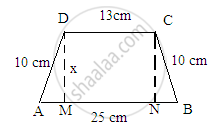
In above figure, we observe that both the right angle trangles AMD and BNC are congruent triangles.
AD = BC = 10 cm
D = CN = x cm
\[\angle DMA = \angle CNB = 90^\circ\]
Hence, the third side of both the triangles will also be equal.
\[ \therefore AM=BN\]
Also, MN=13
Since AB = AM+MN+NB:
\[ \therefore 25=AM+13+BN\]
\[AM+BN=25-13=12 cm\]
\[Or, BN+BN=12 cm (\text{ Because AM=BN })\]
\[2 BN=12\]
\[BN=\frac{12}{2}=6 cm\]
∴ AM = BN = 6 cm.
Now, to find the value of x, we will use the Pythagoras theorem in the right angle triangle AMD, whose sides are 10, 6 and x.
\[ {(\text{ Hypotenuse })}^2 {=(\text{ Base })}^2 {+(\text{ Altitude })}^2 \]
\[ {(10)}^2 {=(6)}^2 {+(x)}^2 \]
\[ {100=36+x}^2 \]
\[ x^2 =100-36=64\]
\[x=\sqrt{64}=8 cm\]
∴ Distance between the parallel sides = 8 cm
∴ Area of trapezium\[=\frac{1}{2}\times( \text{ Sum of parallel sides })\times(\text{ Distance between parallel sides })\]
\[=\frac{1}{2}\times(25+13)\times(8)\]
\[ {=152 cm}^2\]
संबंधित प्रश्न
Length of the fence of a trapezium shaped field ABCD is 120 m. If BC = 48 m, CD = 17 m and AD = 40 m, find the area of this field. Side AB is perpendicular to the parallel sides AD and BC.
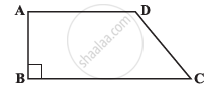
Find the altitude of a trapezium whose area is 65 cm2 and whose bases are 13 cm and 26 cm.
Find the area of a trapezium whose parallel sides of lengths 10 cm and 15 cm are at a distance of 6 cm from each other. Calculate this area as the difference of the area of a rectangle and the sum of the areas of two triangles.
The area of a trapezium is 91 cm2 and its height is 7 cm. If one of the parallel sides is longer than the other by 8 cm, find the two parallel sides.
Mohan wants to buy a trapezium shaped field. Its side along the river is parallel and twice the side along the road. If the area of this field is 10500 m2 and the perpendicular distance between the two parallel sides is 100 m, find the length of the side along the river.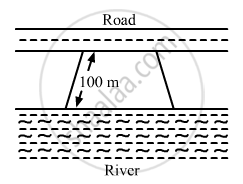
Find the area of the trapezium ABCD in which AB || DC, AB = 18 cm, ∠B = ∠C = 90°, CD = 12 cm and AD = 10 cm.
Find the missing values.
| Height 'h' | Parallel side 'a` | Parallel side 'b` | Area |
| 10 m | 12 m | 20 m |
A window is in the form of trapezium whose parallel sides are 105 cm and 50 cm respectively and the distance between the parallel sides is 60 cm. Find the cost of the glass used to cover the window at the rate of ₹ 15 per 100 sq.cm
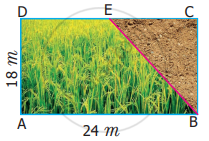
Arivu has a land ABCD with the measurements given in the figure. If a portion ABED is used for cultivation (where E is the mid-point of DC), find the cultivated area.
The perimeter of a trapezium is 52 cm and its each non-parallel side is equal to 10 cm with its height 8 cm. Its area is ______.
