Advertisements
Advertisements
Question
The parallel sides of a trapezium are 25 cm and 13 cm; its nonparallel sides are equal, each being 10 cm, find the area of the trapezium.
Advertisements
Solution
Given:
The parallel sides of a trapezium are 25 cm and 13 cm.
Its nonparallel sides are equal in length and each is equal to 10 cm.
A rough sketch for the given trapezium is given below: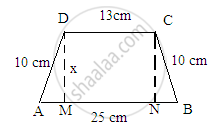
In above figure, we observe that both the right angle trangles AMD and BNC are congruent triangles.
AD = BC = 10 cm
D = CN = x cm
\[\angle DMA = \angle CNB = 90^\circ\]
Hence, the third side of both the triangles will also be equal.
\[ \therefore AM=BN\]
Also, MN=13
Since AB = AM+MN+NB:
\[ \therefore 25=AM+13+BN\]
\[AM+BN=25-13=12 cm\]
\[Or, BN+BN=12 cm (\text{ Because AM=BN })\]
\[2 BN=12\]
\[BN=\frac{12}{2}=6 cm\]
∴ AM = BN = 6 cm.
Now, to find the value of x, we will use the Pythagoras theorem in the right angle triangle AMD, whose sides are 10, 6 and x.
\[ {(\text{ Hypotenuse })}^2 {=(\text{ Base })}^2 {+(\text{ Altitude })}^2 \]
\[ {(10)}^2 {=(6)}^2 {+(x)}^2 \]
\[ {100=36+x}^2 \]
\[ x^2 =100-36=64\]
\[x=\sqrt{64}=8 cm\]
∴ Distance between the parallel sides = 8 cm
∴ Area of trapezium\[=\frac{1}{2}\times( \text{ Sum of parallel sides })\times(\text{ Distance between parallel sides })\]
\[=\frac{1}{2}\times(25+13)\times(8)\]
\[ {=152 cm}^2\]
RELATED QUESTIONS
The area of a trapezium is 91 cm2 and its height is 7 cm. If one of the parallel sides is longer than the other by 8 cm, find the two parallel sides.
The area of a trapezium is 384 cm2. Its parallel sides are in the ratio 3 : 5 and the perpendicular distance between them is 12 cm. Find the length of each one of the parallel sides.
Find the area of the pentagon shown in fig. 20.48, if AD = 10 cm, AG = 8 cm, AH = 6 cm, AF = 5 cm, BF = 5 cm, CG = 7 cm and EH = 3 cm.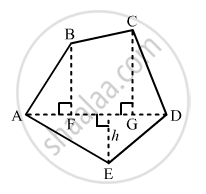
Find the area enclosed by each of the following figures [Fig. 20.49 (i)-(iii)] as the sum of the areas of a rectangle and a trapezium: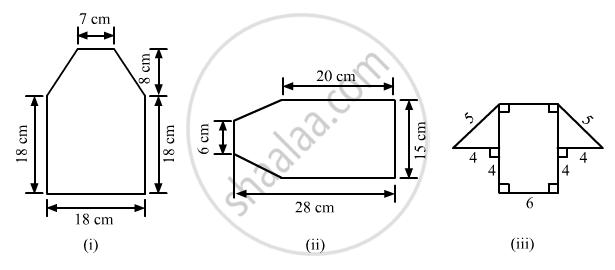
The following figure shows the cross-section ABCD of a swimming pool which is a trapezium in shape.
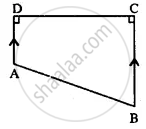
If the width DC, of the swimming pool, is 6.4 m, depth (AD) at the shallow end is 80 cm and depth (BC) at the deepest end is 2.4 m, find its area of the cross-section.
The parallel sides of a trapezium are in ratio 3: 4. If the distance between the parallel sides is 9 dm and its area is 126 dm2; find the lengths of its parallel sides.
The two parallel sides and the distance between them are in the ratio 3: 4: 2. If the area of the trapezium is 175 cm2, find its height.
Find the area of a trapezium whose parallel sides are 24 cm and 20 cm and the distance between them is 15 cm
In a trapezium if the sum of the parallel sides is 10 cm and the area is 140 sq.cm, then the height is
Find the area of the following fields. All dimensions are in metres.

