Advertisements
Advertisements
Question
Find the area of a trapezium whose parallel sides are 25 cm, 13 cm and the other sides are 15 cm each.
Advertisements
Solution
Given:
Parallel sides of a trapezium are 25 cm and 13 cm.
Its nonparallel sides are equal in length and each is equal to 15 cm.
A rough skech of the trapezium is given below:\
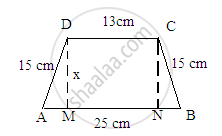
In above figure, we observe that both the right angle triangles AMD and BNC are similar triangles.
This is because both have two common sides as 15 cm and the altitude as x and a right angle.
Hence, the remaining side of both the triangles will be equal.
∴ AM=BN
Also MN=13
Now, since AB=AM+MN+NB:
∴ 25=AM+13+BN
AM+BN=25-13=12 cm
Or, BN+BN=12 cm (Because AM=BN)
2 BN=12
\[BN=\frac{12}{2} = 6cm\]
∴ AM=BN=6 cm
Now, to find the value of x, we will use the Pythagorian theorem in the right angle triangle AMD whose sides are 15, 6 and x.
\[ {(\text{ Hypotenus })}^2 = (\text{ Base })^2 + (\text{ Altitude })^2 \]
\[(15 )^2 = (6 )^2 + (x)2\]
\[225 = 36 + x^2 \]
\[ x^2 = 225 - 36 = 189\]
\[ \therefore x =\sqrt{189}=\sqrt{9 \times 21}= 3\sqrt{21}cm\]
\[ \therefore\text{ Distance between the parallel sides }=3\sqrt{21} cm\]
\[ \therefore\text{ Area of trapezium }=\frac{1}{2} \times(\text{ Sum of parallel sides })\times(\text{ Distance between the parallel sides })\]
\[ = \frac{1}{2} \times(25+13)\times( 3\sqrt{21})\]
\[ = 57\sqrt{21} {cm}^2\]
RELATED QUESTIONS
Find the area, in square metres, of the trapezium whose bases and altitude is as under:
bases = 28 cm and 3 dm, altitude = 25 cm
Find the area, in square metres, of the trapezium whose bases and altitude is as under:
bases = 150 cm and 30 dm, altitude = 9 dm.
If the area of a trapezium is 28 cm2 and one of its parallel sides is 6 cm, find the other parallel side if its altitude is 4 cm.
☐ PQRS is an isosceles trapezium l(PQ) = 7 cm. seg PM ⊥ seg SR, l(SM) = 3 cm, Distance between two parallel sides is 4 cm, find the area of ☐ PQRS.

The following figure shows the cross-section ABCD of a swimming pool which is a trapezium in shape.
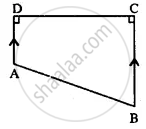
If the width DC, of the swimming pool, is 6.4 m, depth (AD) at the shallow end is 80 cm and depth (BC) at the deepest end is 2.4 m, find its area of the cross-section.
The area of a trapezium is 279 sq.cm and the distance between its two parallel sides is 18 cm. If one of its parallel sides is longer than the other side by 5 cm, find the lengths of its parallel sides.
Find the missing values.
| Height 'h' | Parallel side 'a` | Parallel side 'b` | Area |
| 19 m | 16 m | 323 sq.m |
When the non-parallel sides of a trapezium are equal then it is known as
A trapezium with 3 equal sides and one side double the equal side can be divided into ______ equilateral triangles of ______ area.
The area of a trapezium with equal non-parallel sides is 168 m2. If the lengths of the parallel sides are 36 m and 20 m, find the length of the non-parallel sides.
