Advertisements
Advertisements
Question
The area of a trapezium is 34 cm2 and the length of one of the parallel sides is 10 cm and its height is 4 cm. Find the length of the other parallel side.
Advertisements
Solution
Area of trapezium = 34 cm2
Let the length of the first parallel side = a
Length of second parallel side = b.
Given a = 10 cm
And height (h) = 4 cm
Area of trapezium =12(a + b) × h
34 = 12(10 + b) × 4
or 34 = 20 + 2b
or 34 − 20 = 2b
or 14 = 2b
or 7 = b
Hence, length of the second parallel side = 7 cm
RELATED QUESTIONS
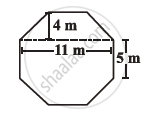
Top surface of a raised platform is in the shape of a regular octagon as shown in the figure. Find the area of the octagonal surface.
Find the altitude of a trapezium whose area is 65 cm2 and whose bases are 13 cm and 26 cm.
The area of a trapezium is 960 cm2. If the parallel sides are 34 cm and 46 cm, find the distance between them.
The area of a trapezium is 91 cm2 and its height is 7 cm. If one of the parallel sides is longer than the other by 8 cm, find the two parallel sides.
Find the area of a trapezium whose parallel sides are 25 cm, 13 cm and the other sides are 15 cm each.
The following figure shows the cross-section ABCD of a swimming pool which is a trapezium in shape.
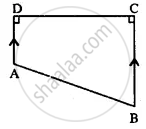
If the width DC, of the swimming pool, is 6.4 m, depth (AD) at the shallow end is 80 cm and depth (BC) at the deepest end is 2.4 m, find its area of the cross-section.
The parallel sides of a trapezium are in ratio 3: 4. If the distance between the parallel sides is 9 dm and its area is 126 dm2; find the lengths of its parallel sides.
The area of a trapezium is 1080 sq.cm. If the lengths of its parallel sides are 55.6 cm and 34.4 cm. Find the distance between them
A window is in the form of trapezium whose parallel sides are 105 cm and 50 cm respectively and the distance between the parallel sides is 60 cm. Find the cost of the glass used to cover the window at the rate of ₹ 15 per 100 sq.cm
Find the area of the following fields. All dimensions are in metres.

