Find the area of the following fields. All dimensions are in metres.
Advertisements
Question
Find the area of the following fields. All dimensions are in metres.

Advertisements
Solution
Area of the given figure
= Area of ΔDCF + Area of ΔEGD + Area of trapezium FCBH + Area of ΔEGA + Area of ΔAHB
∴ Area of ΔDCF = `1/2` × Base × Height
= `1/2 xx 100 xx 100`
= `10000/2`
= 5000 m2
Area of ΔEGD = `1/2` × Base × Height
= `1/2 xx 120 xx 180`
= 60 × 180
= 10800 m2
Area of trapezium = `1/2` × [Sum of parallel sides] × Height
= `1/2 xx [100 + 50] xx 110`
= `1/2 xx 150 xx 110`
= 75 × 110
= 8250 m2
Area of ΔEGA = `1/2` × Base × Height
= `1/2 xx 120 xx 80`
= 60 × 80
= 4800 m2
Area of ΔAHB = `1/2` × Base × Height
= `1/2 xx 50 xx 50`
= 25 × 50
= 1250 m2
Thus, the area of the complete figure
= 5000 + 10800 + 8250 + 4800 + 1250
= 30100 m2
APPEARS IN
RELATED QUESTIONS
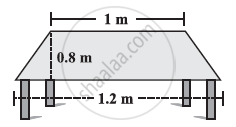
The shape of the top surface of a table is a trapezium. Find its area if its parallel sides are 1 m and 1.2 m and perpendicular distance between them is 0.8 m.
Find the area, in square metres, of the trapezium whose bases and altitude is as under:
bases = 12 dm and 20 dm, altitude = 10 dm
Find the height of a trapezium, the sum of the lengths of whose bases (parallel sides) is 60 cm and whose area is 600 cm2.
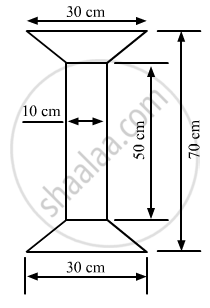
Find the area of Fig. as the sum of the areas of two trapezium and a rectangle.
Find the area of a trapezium whose parallel sides are 25 cm, 13 cm and the other sides are 15 cm each.
There is a pentagonal shaped park as shown in Fig. 20.50. Jyoti and Kavita divided it in two different ways.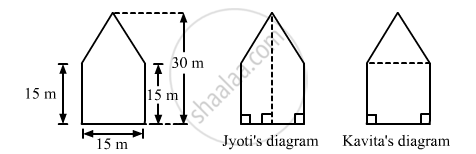
Find the area of this park using both ways. Can you suggest some another way of finding its areas?
The area of a trapezium is 279 sq.cm and the distance between its two parallel sides is 18 cm. If one of its parallel sides is longer than the other side by 5 cm, find the lengths of its parallel sides.
Find the missing values.
| Height 'h' | Parallel side 'a` | Parallel side 'b` | Area |
| 10 m | 12 m | 20 m |
The area of a trapezium is 180 sq.cm and its height is 9 cm. If one of the parallel sides is longer than the other by 6 cm. Find the length of the parallel sides.
Find the area of the shaded portion in the following figure.

