Advertisements
Advertisements
Question
Find the area of the field shown in Fig. 20.39 by dividing it into a square, a rectangle and a trapezium.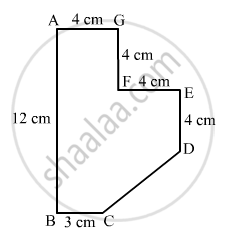
Advertisements
Solution
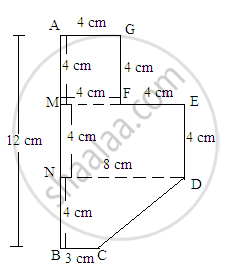
From the above figure:
Area of the figure=(Area of square AGFM with sides 4 cm)+(Area of rectangle MEDN with length 8 cm and width 4 cm)+(Area of trapezium NDCB with parallel sides 8 cm and 3 cm and perpendicular height 4 cm
\[= (4\times4)+(8\times4)+[\frac{1}{2}\times(8+3)\times(4)]\]
\[= 16+32+22\]
\[ {= 70 cm}^2\]
RELATED QUESTIONS
Find the area, in square metres, of the trapezium whose bases and altitude is as under:
bases = 12 dm and 20 dm, altitude = 10 dm
Find the area, in square metres, of the trapezium whose bases and altitude is as under:
bases = 8 m and 60 dm, altitude = 40 dm
Find the sum of the lengths of the bases of a trapezium whose area is 4.2 m2 and whose height is 280 cm.
The area of a trapezium is 384 cm2. Its parallel sides are in the ratio 3 : 5 and the perpendicular distance between them is 12 cm. Find the length of each one of the parallel sides.
The parallel sides of a trapezium are 25 cm and 13 cm; its nonparallel sides are equal, each being 10 cm, find the area of the trapezium.
Find the missing values.
| Height 'h' | Parallel side 'a` | Parallel side 'b` | Area |
| 10 m | 12 m | 20 m |
A window is in the form of trapezium whose parallel sides are 105 cm and 50 cm respectively and the distance between the parallel sides is 60 cm. Find the cost of the glass used to cover the window at the rate of ₹ 15 per 100 sq.cm
The area of the trapezium, if the parallel sides are measuring 8 cm and 10 cm and the height 5 cm is
The perimeter of a trapezium is 52 cm and its each non-parallel side is equal to 10 cm with its height 8 cm. Its area is ______.
The area of a trapezium with equal non-parallel sides is 168 m2. If the lengths of the parallel sides are 36 m and 20 m, find the length of the non-parallel sides.
