Advertisements
Advertisements
Question
Find the area enclosed by each of the following figures [Fig. 20.49 (i)-(iii)] as the sum of the areas of a rectangle and a trapezium: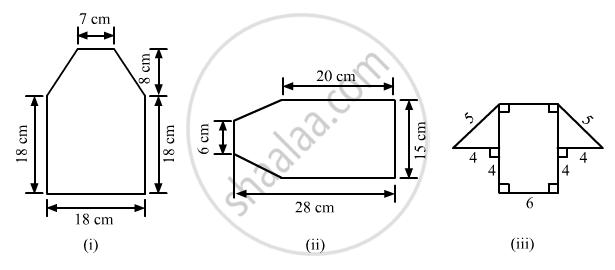
Advertisements
Solution
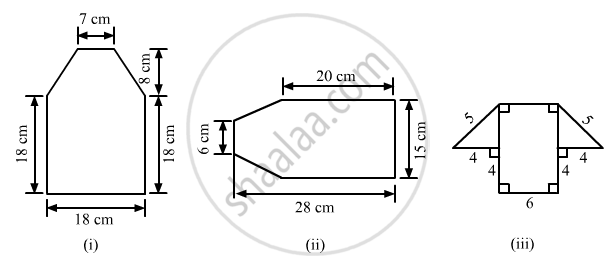 \[(i)\]
The given figure can be divided into a rectangle and a trapezium as shown below:
From the above firgure:
Area of the complete figure = (Area of square ABCF)+(Area of trapezium CDEF)
\[=(AB\times BC)+[\frac{1}{2}\times(FC+ED)\times(\text{ Distance between FC and ED })]\]
\[=(18\times18)+[\frac{1}{2}\times(18+7)\times(8)]\]
\[=324+100\]
\[ {=424 cm}^2\]
\[(ii)\]
The given figure can be divided in the following manner:\]
From the above figure:
AB = AC-BC=28-20=8 cm
So that area of the complete figure = (area of rectangle BCDE)+(area of trapezium ABEF)
\[=(BC\times CD)+[\frac{1}{2}\times(BE+AF)\times(AB)]\]
\[=(20\times15)+[\frac{1}{2}\times(15+6)\times(8)]\]
\[=300+84\]
\[ {=384 cm}^2\]
The given figure can be divided in the following manner:
From the above figure:
EF = AB = 6 cm
Now, using the Pythagoras theorem in the right angle triangle CDE:
\[ 5^2 {= 4}^2 {+CE}^2 \]
\[ {CE}^2 = 25-16=9\]
\[CE =\sqrt{9}= 3 cm\]
\[\text{ And, }GD=GH+HC+CD=4+6+4=14 cm\]
\[ \therefore\text{ Area of the complete figure }= (\text{ Area of rectangle ABCH })+(\text{ Area of trapezium GDEF })\]
\[=(AB\times BC)+[\frac{1}{2}\times(GD+EF)\times(CE)]\]
\[=(6\times4)+[\frac{1}{2}\times(14+6)\times(3)]\]
\[=24+30\]
\[ {=54 cm}^2\]
RELATED QUESTIONS
Find the area of trapezium with base 15 cm and height 8 cm, if the side parallel to the given base is 9 cm long.
Find the height of a trapezium, the sum of the lengths of whose bases (parallel sides) is 60 cm and whose area is 600 cm2.
Find the area of a trapezium whose parallel sides of lengths 10 cm and 15 cm are at a distance of 6 cm from each other. Calculate this area as
the sum of the areas of two triangles and one rectangle.
The cross-section of a canal is a trapezium in shape. If the canal is 10 m wide at the top 6 m wide at the bottom and the area of cross-section is 72 m2 determine its depth.
The parallel sides of a trapezium are 25 cm and 13 cm; its nonparallel sides are equal, each being 10 cm, find the area of the trapezium.
In Fig. 20.38, a parallelogram is drawn in a trapezium, the area of the parallelogram is 80 cm2, find the area of the trapezium.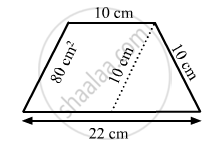
A ground is in the form of isosceles trapezium with parallel sides measuring 42 m and 36 m long. The distance between the parallel sides is 30 m. Find the cost of levelling it at the rate of ₹ 135 per sq.m
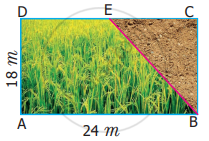
Arivu has a land ABCD with the measurements given in the figure. If a portion ABED is used for cultivation (where E is the mid-point of DC), find the cultivated area.
The area of a trapezium with equal non-parallel sides is 168 m2. If the lengths of the parallel sides are 36 m and 20 m, find the length of the non-parallel sides.
Find the area of the following fields. All dimensions are in metres.

