Advertisements
Advertisements
प्रश्न
Find the area of the field shown in Fig. 20.39 by dividing it into a square, a rectangle and a trapezium.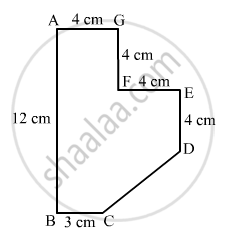
Advertisements
उत्तर
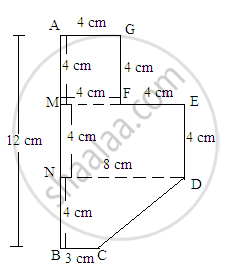
From the above figure:
Area of the figure=(Area of square AGFM with sides 4 cm)+(Area of rectangle MEDN with length 8 cm and width 4 cm)+(Area of trapezium NDCB with parallel sides 8 cm and 3 cm and perpendicular height 4 cm
\[= (4\times4)+(8\times4)+[\frac{1}{2}\times(8+3)\times(4)]\]
\[= 16+32+22\]
\[ {= 70 cm}^2\]
संबंधित प्रश्न
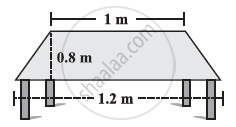
The shape of the top surface of a table is a trapezium. Find its area if its parallel sides are 1 m and 1.2 m and perpendicular distance between them is 0.8 m.
Find the area, in square metres, of the trapezium whose bases and altitude is as under:
bases = 12 dm and 20 dm, altitude = 10 dm
Find the area of trapezium with base 15 cm and height 8 cm, if the side parallel to the given base is 9 cm long.
Find the altitude of a trapezium whose area is 65 cm2 and whose bases are 13 cm and 26 cm.
The cross-section of a canal is a trapezium in shape. If the canal is 10 m wide at the top 6 m wide at the bottom and the area of cross-section is 72 m2 determine its depth.
Mohan wants to buy a trapezium shaped field. Its side along the river is parallel and twice the side along the road. If the area of this field is 10500 m2 and the perpendicular distance between the two parallel sides is 100 m, find the length of the side along the river.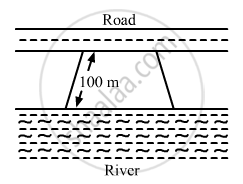
Find the area of a trapezium whose parallel sides are 24 cm and 20 cm and the distance between them is 15 cm
The area of a trapezium is 1080 sq.cm. If the lengths of its parallel sides are 55.6 cm and 34.4 cm. Find the distance between them
A window is in the form of trapezium whose parallel sides are 105 cm and 50 cm respectively and the distance between the parallel sides is 60 cm. Find the cost of the glass used to cover the window at the rate of ₹ 15 per 100 sq.cm
The area of the trapezium, if the parallel sides are measuring 8 cm and 10 cm and the height 5 cm is
