Advertisements
Advertisements
Question
Find the area of the trapezium ABCD in which AB || DC, AB = 18 cm, ∠B = ∠C = 90°, CD = 12 cm and AD = 10 cm.
Advertisements
Solution
In trapezium ABCD,
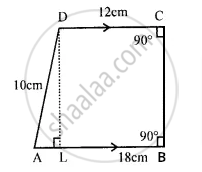
AB || DC, AB = 18 cm
∠B = ∠C = 90°, CD = 12 cm and AD = 10 cm.
Area of trapezium ABCD
Draw DL ⊥ AB
∴ AL = 18 - 12 = 6 cm
DL = BC
DL = `sqrt("AD"^2 - "AL"^2)`
= `sqrt(10^2 - 6^2) = sqrt(100 - 36)`
= `sqrt(64) = 8 "cm"`
Now area of trapezium = `1/2 ("AB + CD") xx "DL"`
= `1/2(18 + 12) xx 8 "cm"^2`
= `1/2 xx 30 xx 8 = 120 "cm"^2`
APPEARS IN
RELATED QUESTIONS
The parallel sides of a trapezium are 25 cm and 13 cm; its nonparallel sides are equal, each being 10 cm, find the area of the trapezium.
Find the area enclosed by each of the following figures [Fig. 20.49 (i)-(iii)] as the sum of the areas of a rectangle and a trapezium: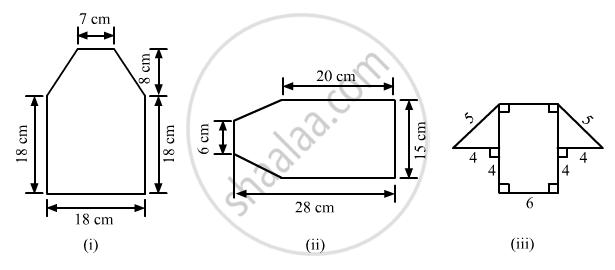
The two parallel sides and the distance between them are in the ratio 3: 4: 2. If the area of the trapezium is 175 cm2, find its height.
Find the missing values.
| Height 'h' | Parallel side 'a` | Parallel side 'b` | Area |
| 13 cm | 28 cm | 492 sq.cm |
The area of the trapezium, if the parallel sides are measuring 8 cm and 10 cm and the height 5 cm is
In a trapezium if the sum of the parallel sides is 10 cm and the area is 140 sq.cm, then the height is
A ground is in the form of isosceles trapezium with parallel sides measuring 42 m and 36 m long. The distance between the parallel sides is 30 m. Find the cost of levelling it at the rate of ₹ 135 per sq.m
The perimeter of a trapezium is 52 cm and its each non-parallel side is equal to 10 cm with its height 8 cm. Its area is ______.
A trapezium with 3 equal sides and one side double the equal side can be divided into ______ equilateral triangles of ______ area.
The area of a trapezium become 4 times if its height gets doubled.
