Advertisements
Advertisements
Question
The area of a rhombus is equal to the area of a triangle. If the base ∆ is 24 cm, its corresponding altitude is 16 cm and one of the diagonals of the rhombus is 19.2 cm. Find its other diagonal.
Advertisements
Solution
Area of a rhombus = Area of a triangle Base of triangle = 24 cm and altitude = 16 cm
∴ Area = `1/2 "base" xx "altitude"`
= `1/2 xx 24 xx 16 = 192` cm2
∴ Area of rhombus = 192 cm2
one diagonal = 19.2 cm
second diagonal = `("Area" xx 2)/"one diagonal"`
= `(192 xx 2)/19.2 = (192 xx 10 xx 2)/192 = 20` cm
APPEARS IN
RELATED QUESTIONS
If perimeter of a rhombus is 100 cm and length of one diagonal is 48 cm, what is the area of the quadrilateral?
The diagonals of a rhombus are 18 cm and 24 cm. Find:
(i) its area ;
(ii) length of its sides.
(iii) its perimeter
A thin metal iron-sheet is rhombus in shape, with each side 10 m. If one of its diagonals is 16 m, find the cost of painting both sides at the rate of ₹ 6 per m2. Also, find the distance between the opposite sides of this rhombus.
Find the area of a rhombus whose base is 14 cm and height is 9 cm.
The area of a rhombus is 100 sq.cm and length of one of its diagonals is 8 cm. Find the length of the other diagonal
The angle between the diagonals of a rhombus is
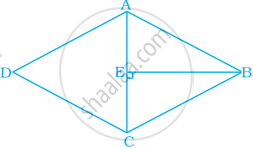
What is the area of the rhombus ABCD below if AC = 6 cm and BE = 4 cm?
The walls and ceiling of a room are to be plastered. The length, breadth and height of the room are 4.5 m, 3 m, and 350 cm respectively. Find the cost of plastering at the rate of Rs 8 per m2.
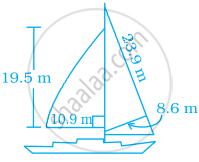
Most of the sailboats have two sails, the jib and the mainsail. Assume that the sails are triangles. Find the total area sail of the sailboats to the nearest tenth.
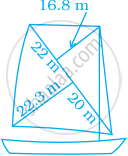
Most of the sailboats have two sails, the jib and the mainsail. Assume that the sails are triangles. Find the total area sail of the sailboats to the nearest tenth.