Advertisements
Advertisements
प्रश्न
Find the area, in square metres, of the trapezium whose bases and altitude is as under:
bases = 28 cm and 3 dm, altitude = 25 cm
Advertisements
उत्तर
Given:
Bases:
\[28 cm =\frac{28}{100}m = 0.28 m\]
And, 3 dm \[=\frac{3}{10}m = 0.3 m\]
Altitude = 25 cm\[ =\frac{25}{100}m = 0.25 m\]
Area of trapezium \[=\frac{1}{2}\times(\text{ Sum of the bases })\times( \text{ Altitude })\]
\[ = \frac{1}{2} \times (0 . 28 + 0 . 3) m \times (0 . 25) m\]
\[ {= 0.0725 m}^2 \]
संबंधित प्रश्न
Find the area, in square metres, of the trapezium whose bases and altitude is as under:
bases = 150 cm and 30 dm, altitude = 9 dm.
Find the area of trapezium with base 15 cm and height 8 cm, if the side parallel to the given base is 9 cm long.
The area of a trapezium is 91 cm2 and its height is 7 cm. If one of the parallel sides is longer than the other by 8 cm, find the two parallel sides.
The parallel sides of a trapezium are 25 cm and 13 cm; its nonparallel sides are equal, each being 10 cm, find the area of the trapezium.
In Fig. 20.38, a parallelogram is drawn in a trapezium, the area of the parallelogram is 80 cm2, find the area of the trapezium.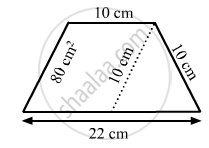
The area of a trapezium is 279 sq.cm and the distance between its two parallel sides is 18 cm. If one of its parallel sides is longer than the other side by 5 cm, find the lengths of its parallel sides.
The area of a trapezium is 1586 sq.cm. The distance between its parallel sides is 26 cm. If one of the parallel sides is 84 cm then find the other side
The area of a trapezium is 180 sq.cm and its height is 9 cm. If one of the parallel sides is longer than the other by 6 cm. Find the length of the parallel sides.
A ground is in the form of isosceles trapezium with parallel sides measuring 42 m and 36 m long. The distance between the parallel sides is 30 m. Find the cost of levelling it at the rate of ₹ 135 per sq.m
The perimeter of a trapezium is 52 cm and its each non-parallel side is equal to 10 cm with its height 8 cm. Its area is ______.
