Advertisements
Advertisements
प्रश्न
Find the area, in square metres, of the trapezium whose bases and altitude is as under:
bases = 28 cm and 3 dm, altitude = 25 cm
Advertisements
उत्तर
Given:
Bases:
\[28 cm =\frac{28}{100}m = 0.28 m\]
And, 3 dm \[=\frac{3}{10}m = 0.3 m\]
Altitude = 25 cm\[ =\frac{25}{100}m = 0.25 m\]
Area of trapezium \[=\frac{1}{2}\times(\text{ Sum of the bases })\times( \text{ Altitude })\]
\[ = \frac{1}{2} \times (0 . 28 + 0 . 3) m \times (0 . 25) m\]
\[ {= 0.0725 m}^2 \]
संबंधित प्रश्न
Find the area, in square metres, of the trapezium whose bases and altitude is as under:
bases = 12 dm and 20 dm, altitude = 10 dm
The area of a trapezium is 960 cm2. If the parallel sides are 34 cm and 46 cm, find the distance between them.
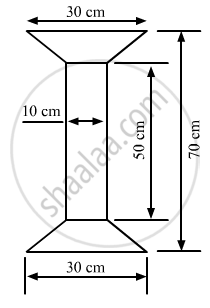
Find the area of Fig. as the sum of the areas of two trapezium and a rectangle.
Find the area of the pentagon shown in fig. 20.48, if AD = 10 cm, AG = 8 cm, AH = 6 cm, AF = 5 cm, BF = 5 cm, CG = 7 cm and EH = 3 cm.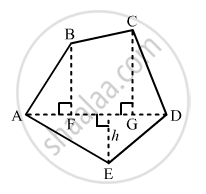
The following figure shows the cross-section ABCD of a swimming pool which is a trapezium in shape.
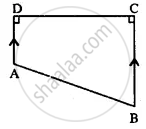
If the width DC, of the swimming pool, is 6.4 m, depth (AD) at the shallow end is 80 cm and depth (BC) at the deepest end is 2.4 m, find its area of the cross-section.
Find the missing values.
| Height 'h' | Parallel side 'a` | Parallel side 'b` | Area |
| 19 m | 16 m | 323 sq.m |
Find the missing values.
| Height 'h' | Parallel side 'a` | Parallel side 'b` | Area |
| 16 cm | 15 cm | 360 sq.cm |
A window is in the form of trapezium whose parallel sides are 105 cm and 50 cm respectively and the distance between the parallel sides is 60 cm. Find the cost of the glass used to cover the window at the rate of ₹ 15 per 100 sq.cm
When the non-parallel sides of a trapezium are equal then it is known as
Find the area of the following fields. All dimensions are in metres.

