Advertisements
Advertisements
प्रश्न
Find the area of the pentagon shown in fig. 20.48, if AD = 10 cm, AG = 8 cm, AH = 6 cm, AF = 5 cm, BF = 5 cm, CG = 7 cm and EH = 3 cm.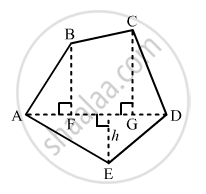
Advertisements
उत्तर
The given figure is:
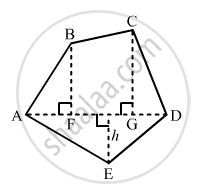
Given:
AD = 10 cm, AG = 8 cm, AH = 6 cm, AF = 5 cm
BF = 5 cm, CG = 7 cm, EH = 3 cm
∴ FG = AG - AF = 8 - 5 = 3 cm
And, GD = AD - AG = 10 - 8 = 2 cm
From given figure:
Area of Pantagon = (Area of triangle AFB) + (Area of trapezium FBCG) + (Area of triangle CGD) + (Area of triangle ADE)
\[= (\frac{1}{2}\times AF \times BF) + [\frac{1}{2} \times (BF + CG) \times (FG)] + (\frac{1}{2} \times GD \times CG) + (\frac{1}{2}\times AD \times EH)\]
\[=(\frac{1}{2} \times 5 \times 5) + [\frac{1}{2} \times (5 + 7) \times (3)] + (\frac{1}{2} \times 2 \times 7) + (\frac{1}{2}\times 10 \times 3)\]
\[= (\frac{25}{2}) + [\frac{36}{2}] + (\frac{14}{2}) + (\frac{30}{2})\]
\[ = 12 . 5 + 18 + 7 + 15\]
\[ {=52.5 cm}^2\]
संबंधित प्रश्न
Find the area, in square metres, of the trapezium whose bases and altitude is as under:
bases = 8 m and 60 dm, altitude = 40 dm
Find the area of a trapezium whose parallel sides are of length 16 dm and 22 dm and whose height is 12 dm.
The area of a trapezium is 960 cm2. If the parallel sides are 34 cm and 46 cm, find the distance between them.
Find the area of the trapezium ABCD in which AB || DC, AB = 18 cm, ∠B = ∠C = 90°, CD = 12 cm and AD = 10 cm.
Find the missing values.
| Height 'h' | Parallel side 'a` | Parallel side 'b` | Area |
| 10 m | 12 m | 20 m |
Find the area of a trapezium whose parallel sides are 24 cm and 20 cm and the distance between them is 15 cm
The area of the trapezium, if the parallel sides are measuring 8 cm and 10 cm and the height 5 cm is
A trapezium with 3 equal sides and one side double the equal side can be divided into ______ equilateral triangles of ______ area.
The area of a trapezium with equal non-parallel sides is 168 m2. If the lengths of the parallel sides are 36 m and 20 m, find the length of the non-parallel sides.
Find the area of the following fields. All dimensions are in metres.

