Advertisements
Advertisements
प्रश्न
Find the area of the following fields. All dimensions are in metres.

Advertisements
उत्तर
Area of the given figure
= Area of ΔEFH + Area of rectangle EDCI + Area of trapezium FHJG + Area of trapezium ICBK + Area of ΔGJA + Area of ΔKBA
Area of ΔEFH = `1/2 xx "Base" xx "Height"`
= `1/2 xx 40 xx 80`
= 40 × 40
= 1600 m2
Area of rectangle EDCI = Length × Breadth = 100 × 160 = 16000 m2
Area of trapezium FHJG = `1/2` × [Sum of parallel sides] × Height
= `1/2 xx [40 + 160] xx 160`
= `200/2 xx 160`
= 100 × 160
= 16000 m2
Area of trapezium ICBK = `1/2` × [Sum of parallel sides] × Height
= `1/2 xx [60 + 100] xx 120`
= `1/2 xx 160 xx 120`
= 80 × 120
= 9600 m2
Area of ΔAJG = `1/2` × Base × Height
= `1/2 xx 160 xx 100`
= 80 × 100
= 8000 m2
Area of ΔKBA = `1/2` × Base × Height
= `1/2 xx 60 xx 60`
= 60 × 30
= 1800 m2
Thus, the area of the complete figure
= 1600 + 16000 + 16000 + 9600 + 8000 + 1800
= 53000 m2
APPEARS IN
संबंधित प्रश्न
Find the area, in square metres, of the trapezium whose bases and altitude is as under:
bases = 8 m and 60 dm, altitude = 40 dm
Find the altitude of a trapezium whose area is 65 cm2 and whose bases are 13 cm and 26 cm.
Find the area of a trapezium whose parallel sides of lengths 10 cm and 15 cm are at a distance of 6 cm from each other. Calculate this area as the difference of the area of a rectangle and the sum of the areas of two triangles.
The area of a trapezium is 384 cm2. Its parallel sides are in the ratio 3 : 5 and the perpendicular distance between them is 12 cm. Find the length of each one of the parallel sides.
Mohan wants to buy a trapezium shaped field. Its side along the river is parallel and twice the side along the road. If the area of this field is 10500 m2 and the perpendicular distance between the two parallel sides is 100 m, find the length of the side along the river.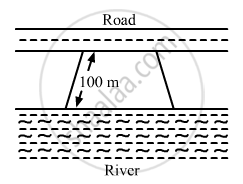
Length of the two parallel sides of a trapezium are 8.5 cm and 11.5 cm respectively and its height is 4.2 cm, find its area.
Find the missing values.
| Height 'h' | Parallel side 'a` | Parallel side 'b` | Area |
| 10 m | 12 m | 20 m |
Find the missing values.
| Height 'h' | Parallel side 'a` | Parallel side 'b` | Area |
| 19 m | 16 m | 323 sq.m |
Find the area of a trapezium whose parallel sides are 24 cm and 20 cm and the distance between them is 15 cm
A trapezium with 3 equal sides and one side double the equal side can be divided into ______ equilateral triangles of ______ area.
