Advertisements
Advertisements
Question
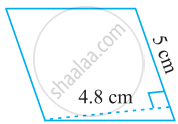
Find the area of the following parallelogram:
Advertisements
Solution
Area of parallelogram = Base × Height
Height = 4.8 cm
Base = 5 cm
Area of parallelogram = 5 × 4.8
= 24 cm2
RELATED QUESTIONS
Find the area of the following parallelogram:
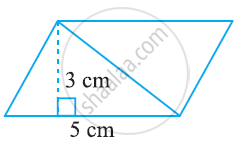
A parallelogram has sides of 15 cm and 12 cm; if the distance between the 15 cm sides is 6 cm; find the distance between 12 cm sides.
A parallelogram has sides of 20 cm and 30 cm. If the distance between its shorter sides is 15 cm; find the distance between the longer sides.
Find the height ‘x’ if the area of the parallelogram is 24 cm2 and the base is 4 cm.
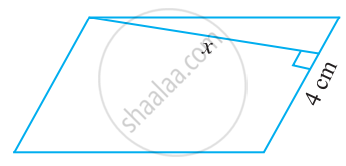
Find the missing values.
| Base | Height | Area |
| 18 cm | 5 cm |
Find the missing values.
| Base | Height | Area |
| 8 cm | 56 sq.m |
Suresh on a parallelogram-shaped trophy in a state level chess tournament. He knows that the area of the trophy is 735 sq.cm and its base is 21 cm. What is the height of that trophy?
If the base and height of a parallelogram are in the ratio 7 : 3 and the height is 45 cm, then fixed the area of the parallelogram
The area of the parallelogram ABCD is 1470 sq.cm. If AB = 49 cm and AD = 35 cm then, find the height, DF and BE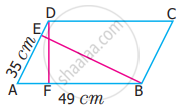
Find the missing value:
| Base | Height | Area of parallelogram |
| 15.6 cm | ______ | 16.38 cm2 |
