Advertisements
Advertisements
Question
Triangles having the same base have equal area.
Options
True
False
Advertisements
Solution
This statement is False.
Explanation:
∵ Area of triangle = `1/2` × Base × Height
So, area of triangle does not only depend on base, it also depends on height.
Hence, if triangles have equal base and equal height, then only their areas are equal.
APPEARS IN
RELATED QUESTIONS
Find the values of k so that the area of the triangle with vertices (1, -1), (-4, 2k) and (-k, -5) is 24 sq. units.
If A(4, –6), B(3, –2) and C(5, 2) are the vertices of ∆ABC, then verify the fact that a median of a triangle ABC divides it into two triangle of equal areas.
Find the area of the quadrilateral ABCD whose vertices are respectively A(1, 1), B(7, –3), C(12, 2) and D(7, 21).
In each of the following find the value of 'k', for which the points are collinear.
(8, 1), (k, -4), (2, -5)
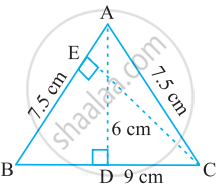
ΔABC is isosceles with AB = AC = 7.5 cm and BC = 9 cm (see the given figure). The height AD from A to BC, is 6 cm. Find the area of ΔABC. What will be the height from C to AB i.e., CE?
Find the centroid of ΔABC whose vertices are A(–1, 0), B(5, –2) and C(8, 2).
For what value of x are the points A(−3, 12), B(7, 6) and C(x, 9) collinear.
What is the area of a triangle with base 4.8 cm and height 3.6 cm?
If `D((-1)/2, 5/2), E(7, 3)` and `F(7/2, 7/2)` are the midpoints of sides of ∆ABC, find the area of the ∆ABC.
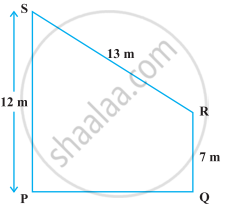
Find the area of the trapezium PQRS with height PQ given in the following figure.