Advertisements
Advertisements
प्रश्न
The table given below contains some measures of the rectangle. Find the unknown values.
| Length | Breadth | Perimeter | Area |
| ? | 15 cm | 60 cm | ? |
Advertisements
उत्तर
b = 15 cm
p = 60 cm
p = 2 (l + b) units
60 = 2(l + 15) cm
`60/2` = l + 15
30 = l + 15
l = 30 – 15
l = 15 cm
Area = l × b unit2
= 15 × 15 cm2
= 225 cm2
A = 225 cm2
Completing the unknown values in the table.
| Length | Breadth | Perimeter | Area |
| 15 cm | 15 cm | 60 cm | 225 cm2 |
APPEARS IN
संबंधित प्रश्न
ABCD is a parallelogram. E is a point on BA such that BE = 2 EA and F is a point on DC
such that DF = 2 FC. Prove that AE CF is a parallelogram whose area is one third of the
area of parallelogram ABCD.
The side of a square is 3.6 cm; find its area.
By counting squares, estimate the area of the figure.
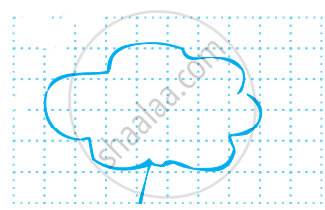
If each square on this page is equal to 1 square meter of land, how much land will each of her children get? ________ square m
Each line gives a story. You have to choose the question which makes the best story problem. The first one is already marked.
- A shopkeeper has 50 boxes. There are 48 fruits in one box.
Tick the one question which matches with the given problem.
Explain why (a) and (c) are not good choices.a) How much will the shopkeeper pay in all? b) How many fruits are there in all? ✓ c) How many more boxes will he need?
Each line gives a story. You have to choose the question which makes the best story problem. The first one is already marked.
- The cost of one book is Rs 47. Sonu buys 23 books.
a) How much money does she have? b) How much money does she pay for the books? c) What is the cost of 47 books?
The region given in the following figure is measured by taking  as a unit. What is the area of the region?
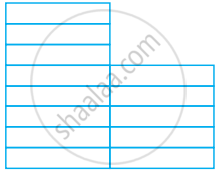
How will you decide? Discuss.
Find the area of the following figure by counting squares:

When using a square centimeter sheet for measurement, the area of one entire square equals:
