Advertisements
Advertisements
प्रश्न
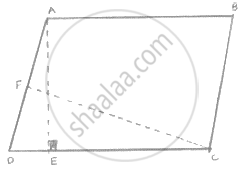
In fig below, ABCD is a parallelogram, AE ⊥ DC and CF ⊥ AD. If AB = 16 cm, AE = 8
cm and CF = 10 cm, find AD.
Advertisements
उत्तर
Given that,
In a parallelogram ABCD,CD = AB = 16cm [Opposite sides of a parallelogram are equal]
We know that,
Area of parallelogram = base corresponding attitude
Area of parallelogram ABCD = CD × AE = AD × CF
16cm × 8cm = AD × 10cm
` A D = (16 × 8 ) / 10 cm = 12 . 8 cm`
Thus, the length of AD is 12 . 8cm
APPEARS IN
संबंधित प्रश्न
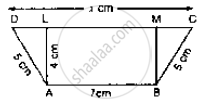
In the below fig. ABCD is a trapezium in which AB = 7 cm, AD = BC = 5 cm, DC = x cm,
and distance between AB and DC is 4cm. Find the value of x and area of trapezium ABCD.
A point D is taken on the side BC of a ΔABC such that BD = 2DC. Prove that ar(Δ ABD) =
2ar (ΔADC).
PQRS is a trapezium having PS and QR as parallel sides. A is any point on PQ and B is a point on SR such that AB || QR. If area of ΔPBQ is 17cm2, find the area of ΔASR.
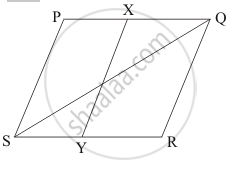
In the given figure, PQRS is a parallelogram. If X and Y are mid-points of PQ and SRrespectively and diagonal Q is joined. The ratio ar (||gm XQRY) : ar (ΔQSR) =
The side of a square is 3.6 cm; find its area.
The side of a square field is 16 m. What will be increase in its area, if each of its sides is increased by 4 m?
Find the area and perimeter of the following parallelograms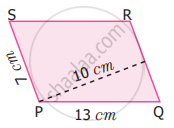
The table given below contains some measures of the rectangle. Find the unknown values.
| Length | Breadth | Perimeter | Area |
| ? | 15 cm | 60 cm | ? |
What is the area of the rectangle? ________ square cm
In the following figure, the area of parallelogram ABCD is ______.