Advertisements
Advertisements
प्रश्न
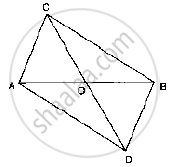
In the below Fig, ABC and ABD are two triangles on the base AB. If line segment CD is
bisected by AB at O, show that ar (Δ ABC) = ar (Δ ABD)
Advertisements
उत्तर
Given that CD is bisected at O by AB
To prove: ar (ΔABC) = ar (ΔABD)
Construction: Draw CP ⊥ AB and DQ ⊥ AB
Proof:-
`ar (ΔABC) = 1/2 xx AB xx CP` ........ (1)
`ar (ΔABC) = 1/2 xx AB xx DQ ` ........ (2)
In ∠CPO and ΔDQO
∠CPQ = ΔDQO [Each 90°]
Given that CO = DO
∠COP = ∠DOQ [vertically opposite angles are equal]
Than, ΔCPO ≅ DQO [By AAS condition]
∴ CP = DQ ........... (3) [CP.C.T]
Compare equation (1), (2) and (3)
Area ( ΔABC)a = area of ΔABD
APPEARS IN
संबंधित प्रश्न
Diagonals AC and BD of a quadrilateral ABCD intersect each other at P. Show that:
ar(ΔAPB) × ar(ΔCPD) = ar(ΔAPD) × ar (ΔBPC)
If P is any point in the interior of a parallelogram ABCD, then prove that area of the
triangle APB is less than half the area of parallelogram.
If AD is a median of a triangle ABC, then prove that triangles ADB and ADC are equal in
area. If G is the mid-point of median AD, prove that ar (Δ BGC) = 2 ar (Δ AGC).
In a ΔABC, D, E, F are the mid-points of sides BC, CA and AB respectively. If ar (ΔABC) = 16cm2, then ar (trapezium FBCE) =
Find the area of a square, whose side is: 4.5 cm.
Find the area of a square, whose side is: 4.1 cm.
Find the area and perimeter of the following parallelograms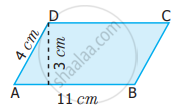
Altogether how many squares can be arranged on it?
In the same way, find the area of piece B.
Find the area of the following figure by counting squares: