Advertisements
Advertisements
प्रश्न
A floor is 40 m long and 15 m broad. It is covered with tiles, each measuring 60 cm by 50 cm. Find the number of tiles required to cover the floor.
Advertisements
उत्तर
Length of floor (l) = 40 m
breadth of floor (b) = 15 m
∴ Area of floor = l × b = 40 × 15 = 600 m2
Length of one tile = 60 cm =`6/10` m
and breadth = 50 cm = `5/10` m
∴ Area of one tile = `6/10xx5/10`
= `30/100=3/10"m"^2`
∴ Number of tiles =`"Total area of floor"/"Area of one tile"`
= `600/(3/10)=(600xx10)/3=2000`
APPEARS IN
संबंधित प्रश्न
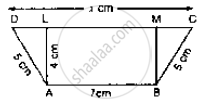
In the below fig. ABCD is a trapezium in which AB = 7 cm, AD = BC = 5 cm, DC = x cm,
and distance between AB and DC is 4cm. Find the value of x and area of trapezium ABCD.
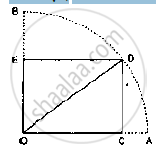
In the below fig. OCDE is a rectangle inscribed in a quadrant of a circle of radius 10 cm. If
OE = 2√5, find the area of the rectangle.
If AD is a median of a triangle ABC, then prove that triangles ADB and ADC are equal in
area. If G is the mid-point of median AD, prove that ar (Δ BGC) = 2 ar (Δ AGC).
If AD is median of ΔABC and P is a point on AC such that
ar (ΔADP) : ar (ΔABD) = 2 : 3, then ar (Δ PDC) : ar (Δ ABC)
ABCD is a trapezium with parallel sides AB =a and DC = b. If E and F are mid-points of non-parallel sides AD and BC respectively, then the ratio of areas of quadrilaterals ABFEand EFCD is
The medians of a triangle ABC intersect each other at point G. If one of its medians is AD,
prove that:
(i) Area ( ΔABD ) = 3 x Area ( ΔBGD )
(ii) Area ( ΔACD ) = 3 x Area ( ΔCGD )
(iii) Area ( ΔBGC ) = `1/3` x Area ( ΔABC ).
The side of a square field is 16 m. What will be increase in its area, if each of its sides is increased by 4 m?
Find the area and perimeter of the following parallelograms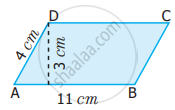
This stamp has an area of 4 square cm. Guess how many such stamps will cover this big rectangle.
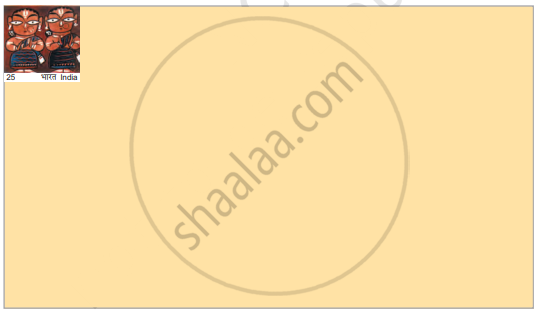
Find the area of the following figure by counting squares:

