Advertisements
Advertisements
प्रश्न
ABCD is a parallelogram whose diagonals AC and BD intersect at O. A line through O
intersects AB at P and DC at Q. Prove that ar (Δ POA) = ar (Δ QOC).
Advertisements
उत्तर

In triangles and , POA QOC we have
∠AOP = ∠COQ [vertically opposite angles]
OA = OC [ Diagonals of a parallelogram bisect each other]
∠PAC = ∠QCA [ AB || DC ; alternative angles ]
So, by ASA congruence criterion, we have
ΔPOA ≅ QOC
Area (ΔPOA) = area (ΔQOC) .
APPEARS IN
संबंधित प्रश्न
Let ABCD be a parallelogram of area 124 cm2. If E and F are the mid-points of sides AB and
CD respectively, then find the area of parallelogram AEFD.
If ABCD is a parallelogram, then prove that
𝑎𝑟 (Δ𝐴𝐵𝐷) = 𝑎𝑟 (Δ𝐵𝐶𝐷) = 𝑎𝑟 (Δ𝐴𝐵𝐶) = 𝑎𝑟 (Δ𝐴𝐶𝐷) = `1/2` 𝑎𝑟 (||𝑔𝑚 𝐴𝐵𝐶𝐷) .
ABC is a triangle in which D is the mid-point of BC. E and F are mid-points of DC and AErespectively. IF area of ΔABC is 16 cm2, find the area of ΔDEF.
Medians of ΔABC intersect at G. If ar (ΔABC) = 27 cm2, then ar (ΔBGC) =
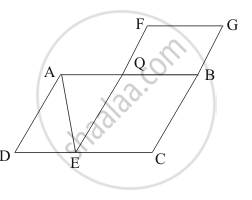
In the given figure, ABCD and FECG are parallelograms equal in area. If ar (ΔAQE) = 12 cm2, then ar (||gm FGBQ) =
Find the area of a rectangle whose length = 24 cm breadth =180 mm
The side of a square field is 16 m. What will be increase in its area, if each of its sides is doubled?
Parth and Gini bought aam papad (dried mango slice) from a shop. Their pieces looked like these. Both could not make out whose piece was bigger.
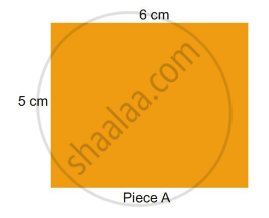

- Suggest some ways to find out whose piece is bigger. Discuss
Area of a rectangle with length 5 cm and breadth 3 cm is ______.
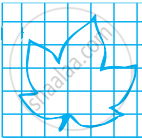
Find the area of the following figure by counting squares: