Advertisements
Advertisements
प्रश्न
ABCD is a parallelogram whose diagonals AC and BD intersect at O. A line through O
intersects AB at P and DC at Q. Prove that ar (Δ POA) = ar (Δ QOC).
Advertisements
उत्तर

In triangles and , POA QOC we have
∠AOP = ∠COQ [vertically opposite angles]
OA = OC [ Diagonals of a parallelogram bisect each other]
∠PAC = ∠QCA [ AB || DC ; alternative angles ]
So, by ASA congruence criterion, we have
ΔPOA ≅ QOC
Area (ΔPOA) = area (ΔQOC) .
APPEARS IN
संबंधित प्रश्न
ABCD is a parallelogram in which BC is produced to E such that CE = BC. AE intersects
CD at F.
(i) Prove that ar (ΔADF) = ar (ΔECF)
(ii) If the area of ΔDFB = 3 cm2, find the area of ||gm ABCD.
In square ABCD, P and Q are mid-point of AB and CD respectively. If AB = 8cm and PQand BD intersect at O, then find area of ΔOPB.
ABCD is a parallelogram. P is any point on CD. If ar (ΔDPA) = 15 cm2 and ar (ΔAPC) = 20 cm2, then ar (ΔAPB) =
A, B, C, D are mid-points of sides of parallelogram PQRS. If ar (PQRS) = 36 cm2, then ar (ABCD) =
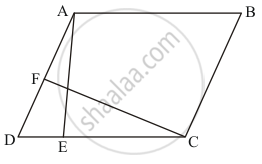
In the given figure, ABCD is a parallelogram. If AB = 12 cm, AE = 7.5 cm, CF = 15 cm, then AD =
Find the area of a rectangle whose length = 15 cm breadth = 6.4 cm
By counting squares, estimate the area of the figure.

The table given below contains some measures of the rectangle. Find the unknown values.
| Length | Breadth | Perimeter | Area |
| ? | 15 cm | 60 cm | ? |
In the same way, find the area of piece B.
Find the area of the following figure by counting squares: