Advertisements
Advertisements
Question
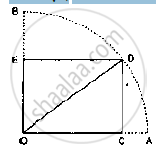
In the below fig. OCDE is a rectangle inscribed in a quadrant of a circle of radius 10 cm. If
OE = 2√5, find the area of the rectangle.
Advertisements
Solution
Given OD = 10cm and OE `root (2)(5)cm`
By using Pythagoras theorem
∴ `OD^2 = OE^2 + DE^2`
⇒ `DE = sqrt( OD^2 - OF^2)` = ` sqrt (( 10 )^2 - (root2(5)))^2` = `root 4 (5)cm`
∴ `ar (rect DCDE) = OExx DE = root2( 5) xx root 4 (5 )cm^2`
= `40 cm^ 2 [ ∴ sqrt5 xx sqrt 5 = 5]`
APPEARS IN
RELATED QUESTIONS
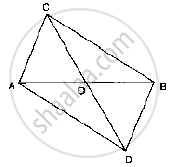
In the below Fig, ABC and ABD are two triangles on the base AB. If line segment CD is
bisected by AB at O, show that ar (Δ ABC) = ar (Δ ABD)
PQRS is a trapezium having PS and QR as parallel sides. A is any point on PQ and B is a point on SR such that AB || QR. If area of ΔPBQ is 17cm2, find the area of ΔASR.
The mid-points of the sides of a triangle ABC along with any of the vertices as the fourth point make a parallelogram of area equal to ______.
The side of a square is 3.6 cm; find its area.
Which has the bigger area - one of your footprints or the page of this book?
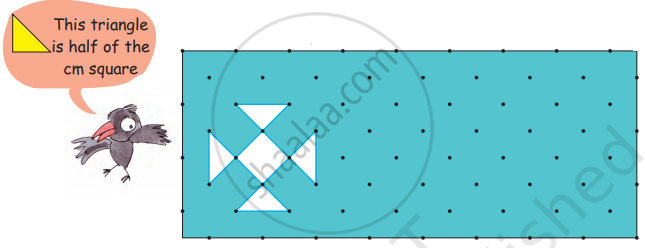
How many tiles like the triangle given here will fit in the white design?
Area of design = ________ square cm
Each line gives a story. You have to choose the question which makes the best story problem. The first one is already marked.
- The cost of one book is Rs 47. Sonu buys 23 books.
a) How much money does she have? b) How much money does she pay for the books? c) What is the cost of 47 books?
An engineer who plans to build a compound wall on all sides of a house must find the area of the compound.
The region given in the following figure is measured by taking  as a unit. What is the area of the region?
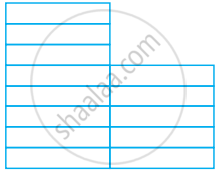
Find the area of the following figure by counting squares: