Advertisements
Advertisements
प्रश्न
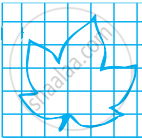
Find the area of the following figure by counting squares:
Advertisements
उत्तर
From the given figure, we observe
| Covered Area | Number | Area estimate (square units) |
| Fully filled squares | 5 | 5 |
| Half filled squares | – | – |
| More than half-filled squares | 9 | 9 |
| Less than half-filled squares | 12 | 0 |
Therefore total area = 5 + 9 = 14 square units.
संबंधित प्रश्न
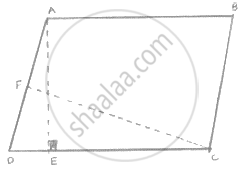
In fig below, ABCD is a parallelogram, AE ⊥ DC and CF ⊥ AD. If AB = 16 cm, AE = 8
cm and CF = 10 cm, find AD.
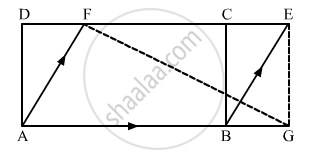
In the given figure, ABCD is a rectangle with sides AB = 10 cm and AD = 5 cm. Find the area of ΔEFG.
Medians of ΔABC intersect at G. If ar (ΔABC) = 27 cm2, then ar (ΔBGC) =
Find the area of a rectangle whose length = 3.6 m breadth = 90 cm
Find the area of a square, whose side is: 7.2 cm.
The side of a square field is 16 m. What will be increase in its area, if each of its sides is increased by 4 m?
Look at a 10 rupee note. Is its area more than hundred square cm?
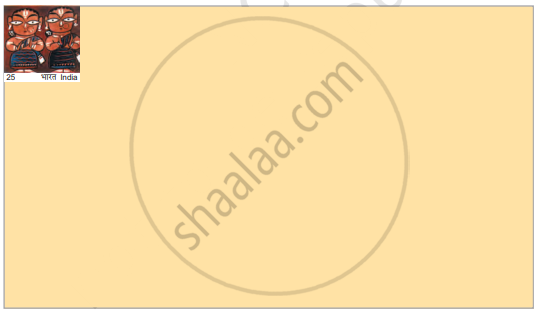
This stamp has an area of 4 square cm. Guess how many such stamps will cover this big rectangle.
If each square on this page is equal to 1 square meter of land, how much land will each of her children get? ________ square m
The King was very happy with carpenters Cheggu and Anar. They had made a very big and beautiful bed for him. So as gifts the king wanted to give some land to Cheggu, and some gold to Anar. Cheggu was happy. He took 100 meters of wire and tried to make different rectangles.
He made a 10 m × 40 m rectangle. Its area was 400 square meters. So he next made a 30 m × 20 m rectangle.
- What is its area? Is it more than the first rectangle?
