Advertisements
Advertisements
प्रश्न
The table given below contains some measures of the rectangle. Find the unknown values.
| Length | Breadth | Perimeter | Area |
| 13 cm | ? | 54 cm | ? |
Advertisements
उत्तर
l = 13 cm
p = 54 cm
Perimeter = 2(l + b) units
54 = 2(13 + b) cm
`54/2` = 13 + b
27 = 13 + b
b = 27 – 13
b = 14 cm
Area = l × b sq.unit
= 13 × 14 cm2
A = 182 cm2
Completing the unknown values in the table.
| Length | Breadth | Perimeter | Area |
| 13 cm | 14 cm | 54 cm | 182 cm2 |
APPEARS IN
संबंधित प्रश्न
ABCD is a parallelogram whose diagonals AC and BD intersect at O. A line through O
intersects AB at P and DC at Q. Prove that ar (Δ POA) = ar (Δ QOC).
The sides of a rectangular park are in the ratio 4 : 3. If its area is 1728 m2, find
(i) its perimeter
(ii) cost of fencing it at the rate of ₹40 per meter.
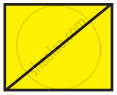
Is the area of the blue shape more than the area of the yellow shape? Why?

Each line gives a story. You have to choose the question which makes the best story problem. The first one is already marked.
- A shopkeeper has 50 boxes. There are 48 fruits in one box.
Tick the one question which matches with the given problem.
Explain why (a) and (c) are not good choices.a) How much will the shopkeeper pay in all? b) How many fruits are there in all? ✓ c) How many more boxes will he need?
Whose footprint is larger - yours or your friend’s?
How will you decide? Discuss.
Is the area of both your footprints the same?
Find the area of the following figure by counting squares:

Find the area of the following figure by counting squares:

What is the area of a closed shape?
