Advertisements
Advertisements
Question
Each line gives a story. You have to choose the question which makes the best story problem. The first one is already marked.
- A shopkeeper has 204 eggs. He puts them in egg trays. Each tray has 12 eggs.
a) How many more eggs will he need? b) How many fresh eggs does he sell? c) How many egg trays does he need?
Advertisements
Solution
| a) | How many more eggs will he need? | |
| b) | How many fresh eggs does he sell? | |
| c) | How many egg trays does he need? | ✓ |
Option (a) is not a good choice because the total number of eggs is already given.
Option (b) is not a good choice because there is no data on the number of fresh or spoiled eggs.
RELATED QUESTIONS
Diagonals AC and BD of a quadrilateral ABCD intersect each other at P. Show that:
ar(ΔAPB) × ar(ΔCPD) = ar(ΔAPD) × ar (ΔBPC)
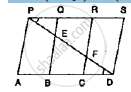
In below fig., PSDA is a parallelogram in which PQ = QR = RS and AP || BQ || CR. Prove
that ar (Δ PQE) = ar (ΔCFD).
If ABC and BDE are two equilateral triangles such that D is the mid-point of BC, then find ar (ΔABC) : ar (ΔBDE).
Let ABC be a triangle of area 24 sq. units and PQR be the triangle formed by the mid-points of the sides of Δ ABC. Then the area of ΔPQR is
The area of the figure formed by joining the mid-points of the adjacent sides of a rhombus with diagonals 16 cm and 12 cm is
Medians of ΔABC intersect at G. If ar (ΔABC) = 27 cm2, then ar (ΔBGC) =
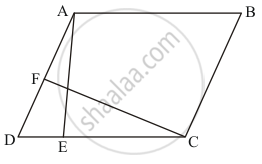
In the given figure, ABCD is a parallelogram. If AB = 12 cm, AE = 7.5 cm, CF = 15 cm, then AD =
ABCD is a rectangle with O as any point in its interior. If ar (ΔAOD) = 3 cm2 and ar (ΔABOC) = 6 cm2, then area of rectangle ABCD is
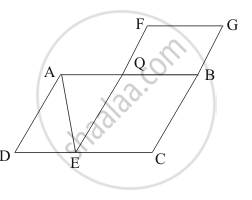
In the given figure, ABCD and FECG are parallelograms equal in area. If ar (ΔAQE) = 12 cm2, then ar (||gm FGBQ) =
The diagonal of a rectangular board is 1 m and its length is 96 cm. Find the area of the board.
The length and breadth of a rectangular piece of land are in the ratio 5 : 3. If the total cost of fencing it at the rate of ₹24 per meter is ₹9600, find its :
(i) length and breadth
(ii) area
(iii) cost of levelling at the rate of ₹60 per m2.
What will happen to the area of a rectangle, if its length and breadth both are trebled?
The side of a square field is 16 m. What will be increase in its area, if each of its sides is increased by 4 m?
The table given below contains some measures of the rectangle. Find the unknown values.
| Length | Breadth | Perimeter | Area |
| 13 cm | ? | 54 cm | ? |
Which has the smaller area - two five-rupee notes together or a hundred rupee notes?
Is the area of the blue shape more than the area of the yellow shape? Why?
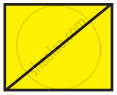

In the same way, find the area of piece B.
This stamp has an area of 4 square cm. Guess how many such stamps will cover this big rectangle.
Measure the length of the floor of your classroom in meters. Also measure the width.
- If you want to move around easily then how many children do you think should be there in one square meter?
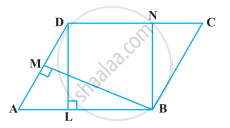
In the following figure, the area of parallelogram ABCD is ______.
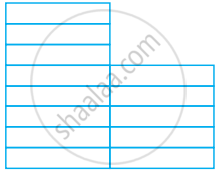
The region given in the following figure is measured by taking  as a unit. What is the area of the region?
Whose footprint is larger - yours or your friend’s?
Is the area of both your footprints the same?
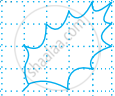
Find the area of the following figure by counting squares:

Find the area of the following figure by counting squares:

Find the area of the following figure by counting squares:
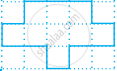
Find the area of the following figure by counting squares:
When using a square centimeter sheet for measurement, the area of one entire square equals:
