Advertisements
Advertisements
Question
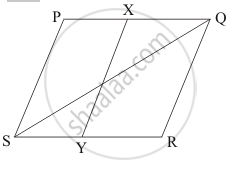
In the given figure, PQRS is a parallelogram. If X and Y are mid-points of PQ and SRrespectively and diagonal Q is joined. The ratio ar (||gm XQRY) : ar (ΔQSR) =
Options
1 : 4
2 : 1
1 : 2
1 : 1
Advertisements
Solution
Given: (1) PQRS is a parallelogram.
(2) X is the midpoint of PQ.
(3) Y is the midpoint of SR.
(4) SQ is the diagonal.
To find: Ratio of area of ||gm XQRY : area of ΔQRS.
Calculation: We know that the triangle and parallelogram on the same base and between the same parallels are equal in area.
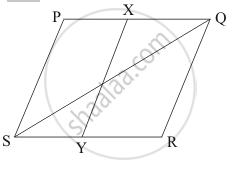
∴ Ar (||gm PQRS) = Ar (ΔQRS)
`Ar ( "||"^(gm) XQRY ) = 1/2 Ar ("||"^(gm) PQRS)`
(since X is the mid point of PQ and Y is the midpoint of SR)
`Ar ("||"^(gm) XQRY) = Ar (ΔQRS)`
`Ar ("||"^(gm) XQRY ) : Ar (ΔQRS) = 1:1`
APPEARS IN
RELATED QUESTIONS
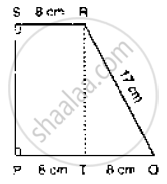
Compute the area of trapezium PQRS is Fig. below.
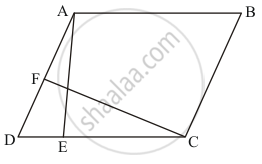
In the given figure, ABCD is a parallelogram. If AB = 12 cm, AE = 7.5 cm, CF = 15 cm, then AD =
In the given figure, ABCD and FECG are parallelograms equal in area. If ar (ΔAQE) = 12 cm2, then ar (||gm FGBQ) =
The sides of a rectangular park are in the ratio 4 : 3. If its area is 1728 m2, find
(i) its perimeter
(ii) cost of fencing it at the rate of ₹40 per meter.
Find the area of a rectangle whose length = 15 cm breadth = 6.4 cm
Find the area of a rectangle whose length = 24 cm breadth =180 mm
Find the area of a square, whose side is: 4.1 cm.
The side of a square is 3.6 cm; find its area.
Each side of a square is 7 m. If its each side be increased by 3 m, what will be the increase in its area.
Whose footprint is larger - yours or your friend’s?
