Advertisements
Advertisements
प्रश्न
The perimeter of a square is 60 m, find:
(i) its each side its area
(ii) its new area obtained on increasing
(iii) each of its sides by 2 m.
Advertisements
उत्तर
Perimeter of a square = 60 m
(i) Perimeter of a square = 4 x side
60 m = 4 x side
`60/4` = side 4
∴side = 15 m
(ii) Area of square = (side)² = (15 m)²
= 15 m x 15 m
= 225 m²
(iii) Increased each side = 2 m
Side of square = 15 m
New length of side = (2m + 15m)
= 17m
∴ New Area of square = (17m)² = 17m x 17m = 289 m2
APPEARS IN
संबंधित प्रश्न
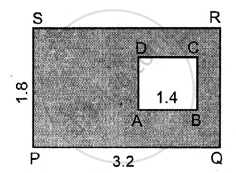
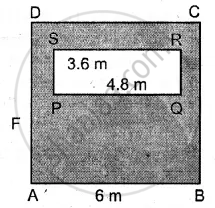
In each of the following cases, ABCD is a square and PQRS is a rectangle. Find, in each case, the area of the shaded portion.
(All measurements are in metre).
(i)
(ii)
Find the perimeter of a rectangle whose:
length = 40 cm and breadth = 35 cm
Find the perimeter of a rectangle whose:
length = 8 m and breadth = 80 cm
A rectangle with length = 18 cm and breadth = 12 cm has same perimeter as that of a regular pentagon. Find the side of the pentagon.
How much wire will be needed to make a rectangle 7 cm long and 4 cm wide?
The length of a rectangular plot of land is 50 m and its width is 30 m. A triple fence has to be put along its edges. If the wire costs 60 rupees per metre, what will be the total cost of the wire needed for the fence?
A game requires its players to run around a square playground. Each side of the playground is 20 m long. One player took 5 rounds around the playground. How many metres did he run altogether?
The length of a rectangle is three times its breadth. If its perimeter is 64 cm, find the sides of the rectangle
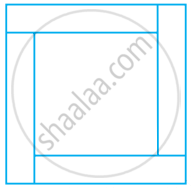
A large square is made by arranging a small square surrounded by four congruent rectangles as shown in the following figure. If the perimeter of each of the rectangle is 16 cm, find the area of the large square.
Why is the perimeter of a rectangle calculated as 2 × (length + breadth)?
