Advertisements
Advertisements
प्रश्न
Each rectangular tile is 40 cm long and 30 cm wide. How many tiles will be required to cover the floor of a room with length = 4.8 m and breadth = 2.4 m.
Advertisements
उत्तर
The dimensions of each tile:
- Length = 40 cm = 0.4 m
- Width = 30 cm = 0.3 m
The area of each tile: Tile Area = Length × Width
= 0.4 × 0.3 = 0.12 m2
The dimensions of the room:
- Length = 4.8 m
- Breadth = 2.4 m
Room Area = Length × Breadth
= 4.8 × 2.4 = 11.52 m2
The number of tiles required is:
`"Number of Tiles"="Room Area"/"Tile Area" = 11.52/0.12`
= 96
APPEARS IN
संबंधित प्रश्न
Each side of a rectangle is doubled. Find the ratio between :
(i) perimeters of the original rectangle and the resulting rectangle.
(ii) areas of the original rectangle and the resulting rectangle.
An equilateral triangle and d square has equal perimeter. If side of the triangle is 9.6 cm ; what is the length of the side of the square?
An athlete takes 10 rounds of a rectangular park, 50 m long and 25 m wide. Find the total distance covered by him.
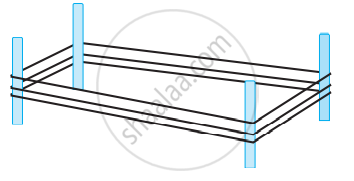
A farmer has a rectangular field of length and breadth 240 m and 180 m respectively. He wants to fence it with 3 rounds of rope as shown in the figure. What is the total length of rope he must use?
Find the perimeter of the following figure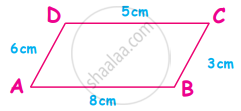
Find the cost of fencing a rectangular park of length 175 m and breadth of 125 m at the rate of ₹ 12 per metre.
36 unit squares are joined to form a rectangle with the least perimeter. Perimeter of the rectangle is ______.
What is the radius of the largest circle that can be cut out of the rectangle measuring 10 cm in length and 8 cm in breadth?
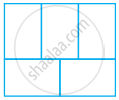
In the following figure, a rectangle with perimeter 264 cm is divided into five congruent rectangles. Find the perimeter of one of the rectangles.
What is the correct formula for the perimeter of a rectangle with length (l) and breadth (b)?
