Advertisements
Advertisements
Question
Each rectangular tile is 40 cm long and 30 cm wide. How many tiles will be required to cover the floor of a room with length = 4.8 m and breadth = 2.4 m.
Advertisements
Solution
The dimensions of each tile:
- Length = 40 cm = 0.4 m
- Width = 30 cm = 0.3 m
The area of each tile: Tile Area = Length × Width
= 0.4 × 0.3 = 0.12 m2
The dimensions of the room:
- Length = 4.8 m
- Breadth = 2.4 m
Room Area = Length × Breadth
= 4.8 × 2.4 = 11.52 m2
The number of tiles required is:
`"Number of Tiles"="Room Area"/"Tile Area" = 11.52/0.12`
= 96
APPEARS IN
RELATED QUESTIONS
A path of uniform width, 2.5 m, runs around the inside of a rectangular field 30 m by 27 m. Find the area of the path.
Find the perimeter of a rectangle whose:
length = 10 m and breadth = 8 m
Find the perimeter of a regular hexagon of side 6.5 cm.
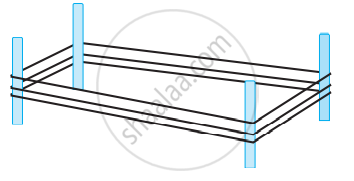
A farmer has a rectangular field of length and breadth 240 m and 180 m respectively. He wants to fence it with 3 rounds of rope as shown in the figure. What is the total length of rope he must use?
The length of a rectangle is three times its breadth. If its perimeter is 64 cm, find the sides of the rectangle
Find the perimeter of the following figure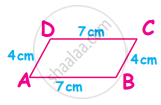
Length of a rectangle is three times its breadth. Perimeter of the rectangle is 40 cm. Find its length and width.
The area of a rectangular field is 1600 sq m. If the length of the field is 80 m, find the perimeter of the field.
On a centimetre squared paper, make as many rectangles as you can, such that the area of the rectangle is 16 sq cm (consider only natural number lengths).
- Which rectangle has the greatest perimeter?
- Which rectangle has the least perimeter?
- If you take a rectangle of an area of 24 sq cm, what will be your answers?
Why is the perimeter of a rectangle calculated as 2 × (length + breadth)?
