Advertisements
Advertisements
प्रश्न
The area of the figure formed by joining the mid-points of the adjacent sides of a rhombus with diagonals 16 cm and 12 cm is
पर्याय
28 cm2
48 cm2
96 cm2
24 cm2
Advertisements
उत्तर
Given: Rhombus with diagonals measuring 16cm and 12 cm.
To find: Area of the figure formed by lines joining the midpoints of the adjacent sides.
Calculation: We know that, ‘Area of a rhombus is half the product of their diagonals’.

H and F are the midpoints of AD and BC respectively.
`AH = 1/2 AD `
`BE = 1/2 BC`
Now ABCD is a parallelogram which means
`AD = BC `
`1/2AD = 1/2BC`
AH = BF ……..(1)
Also , AD || BC
AH || BF ……(2)
From 1 and 2 we get that ABFH is a parallelogram.
Since Parallelogram FHAB and ΔFHE are on the base FH and between the same parallels HF and AB.
∴` ar (Δ FHE ) = 1/2 ar ( "||"^(gm) FHAB )` ……(3)
Similarly ,
`ar (ΔFHG) = 1/2ar ("||"^(gm) FHDC)` ……(4)
Adding 3 and 4 we get,
`ar (Δ FHE ) + ar (ΔFHG) = 1/2 ar ("||"^(gm) FHAB)+1/2ar("||"^(gm)FHDC)`
`ar (EFGH) = 1/2 (ar("||"^(gm) FHAB ) + ar ("||"^(gm) FHDC))`
`ar (EFGH) = 1/2 (ar("||"^(gm) ABCD))`
`ar (EFGH) = 1/2 (1/2 (16xx12))`
`ar (EFGH) = 1/4 (16 xx 12)`
`ar (EFGH) = 48 cm^2`
APPEARS IN
संबंधित प्रश्न
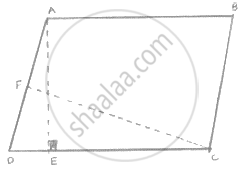
In fig below, ABCD is a parallelogram, AE ⊥ DC and CF ⊥ AD. If AB = 16 cm, AE = 8
cm and CF = 10 cm, find AD.
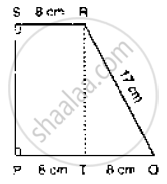
Compute the area of trapezium PQRS is Fig. below.
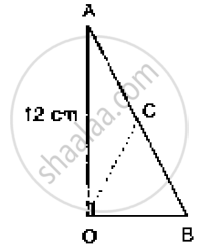
In the below fig. ∠AOB = 90°, AC = BC, OA = 12 cm and OC = 6.5 cm. Find the area of
ΔAOB.
ABC is a triangle in which D is the mid-point of BC. E and F are mid-points of DC and AErespectively. IF area of ΔABC is 16 cm2, find the area of ΔDEF.
A triangle and a parallelogram are on the same base and between the same parallels. The ratio of the areas of triangle and parallelogram is
Find the area of a rectangle whose length = 3.6 m breadth = 90 cm
The amount of region enclosed by a plane closed figure is called its ______.
Area of a rectangle with length 5 cm and breadth 3 cm is ______.
Find the area of the following figure by counting squares:

Find the area of the following figure by counting squares: