English

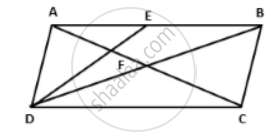
In Parallelogram Abcd, E is a Point in Ab and De Meets Diagonal Ac at Point F. If Df: Fe = 5:3 and Area Of δAdf is 60 Cm2; Find (I) Area of δAde. (Ii) If Ae: Eb = 4:5, Find the Area Of δAdb.

Advertisements
Advertisements

Question

In parallelogram ABCD, E is a point in AB and DE meets diagonal AC at point F. If DF: FE = 5:3 and area of  ΔADF is 60 cm2; find
(i) area of ΔADE.
(ii) if AE: EB = 4:5, find the area of  ΔADB.
(iii) also, find the area of parallelogram ABCD.

Sum
Advertisements

Solution


ΔADF and ΔAFE have the same vertex A and their bases are on the same straight line DE.
∴ `"A(ΔADF)"/"A(ΔAFE)" = "DF"/"FE"`

⇒ `60/"A(ΔAFE)" = 5/3 `

⇒ A(ΔAFE) = `( 60 xx 3 )/5` = 36cm2.

Now, A(ΔADE) = A(ΔADF) + A(ΔAFE) = 60 + 36 = 96 cm2.

ΔADE and ΔEDB have the same vertex D and their bases are on the same straight line AB.\

∴ `"A( ΔADE )"/"A( ΔEDB )" = "AE"/"EB"`

⇒ `96/"A( ΔEDB )" = 4/5`

⇒ A( ΔEDB ) = `( 96 xx 5 )/4` = 120 cm.

Now, A( ΔADB ) and ||m ABCD are on the same base AB and between the same parallels AB and DC.

∴ A( ΔADB ) = `1/2` A( ||m ABCD ) 

⇒ 216 = `1/2` A( ||m ABCD ) 

⇒ A( ||m ABCD ) = 2 x 216 = 432 cm2 .

shaalaa.com
Figures Between the Same Parallels
  Is there an error in this question or solution?
Chapter 16: Area Theorems [Proof and Use] - Exercise 16 (C) [Page 202]

APPEARS IN

Selina Concise Mathematics [English] Class 9 ICSE
Chapter 16 Area Theorems [Proof and Use]
Exercise 16 (C) | Q 7 | Page 202

RELATED QUESTIONS

In the given figure, if the area of triangle ADE is 60 cm2, state, given reason, the area of :
(i) Parallelogram ABED;
(ii) Rectangle ABCF;
(iii) Triangle ABE.


The given figure shows a rectangle ABDC and a parallelogram ABEF; drawn on opposite sides of AB.
Prove that: 
(i) Quadrilateral CDEF is a parallelogram;
(ii) Area of the quad. CDEF
= Area of rect. ABDC + Area of // gm. ABEF.


In the given figure, D is mid-point of side AB of ΔABC and BDEC is a parallelogram.

Prove that: Area of ABC = Area of // gm BDEC.


In the given figure, diagonals PR and QS of the parallelogram PQRS intersect at point O and LM is parallel to PS. Show that:

(i) 2 Area (POS) = Area (// gm PMLS)
(ii) Area (POS) + Area (QOR) = Area (// gm PQRS)
(iii) Area (POS) + Area (QOR) = Area (POQ) + Area (SOR).


In the given figure, M and N are the mid-points of the sides DC and AB respectively of the parallelogram ABCD.

If the area of parallelogram ABCD is 48 cm2;
(i) State the area of the triangle BEC.
(ii) Name the parallelogram which is equal in area to the triangle BEC.


In the figure given alongside, squares ABDE and AFGC are drawn on the side AB and the hypotenuse AC of the right triangle ABC.

If BH is perpendicular to FG

prove that:

  1. ΔEAC ≅ ΔBAF
  2. Area of the square ABDE
  3. Area of the rectangle ARHF.

In the given figure, AP is parallel to BC, BP is parallel to CQ.
Prove that the area of triangles ABC and BQP are equal.


ABCD is a trapezium with AB parallel to DC. A line parallel to AC intersects AB at X and BC at Y.
Prove that the area of ∆ADX = area of ∆ACY.


In the given figure, the diagonals AC and BD intersect at point O. If OB = OD and AB//DC,
show that:
(i) Area (Δ DOC) = Area (Δ AOB).
(ii) Area (Δ DCB) = Area (Δ ACB).
(iii) ABCD is a parallelogram.


Show that:
The ratio of the areas of two triangles on the same base is equal to the ratio of their heights.


Share
Notifications

Englishहिंदीमराठी


      Forgot password?
Use app×