Advertisements
Advertisements
Question
ABCD is a parallelogram. P and Q are the mid-points of sides AB and AD respectively.
Prove that area of triangle APQ = `1/8` of the area of parallelogram ABCD.
Advertisements
Solution
We have to join PD and BD.
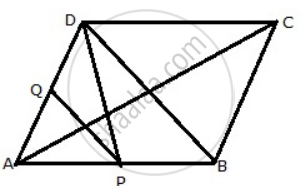
BD is the diagonal of the parallelogram ABCD. Therefore it divides the parallelogram into two equal parts.
∴ Area( ΔABD )= Area ( ΔDBC )
=`1/2` Area ( parallelogram ABCD) ...(i)
DP is the median of ΔABD. Therefore it will divide ΔABD into two triangles of equal areas.
∴ Area( ΔAPD )= Area ( ΔDPB )
= `1/2` Area ( ΔABD )
= `1/2 xx 1/2` Area (parallelogram ABCD) ...[from equation (i)]
= `1/4` Area (parallelogram ABCD) ...(ii)
In ΔAPD, Q is the mid-point of AD. Therefore PQ is the median.
∴ Area(ΔAPQ)= Area (ΔDPQ)
= `1/2` Area (ΔAPD)
= `1/2 xx 1/4` Area (parallelogram ABCD)...[from equation (ii)]
Area (ΔAPQ)= `1/8` Area (parallelogram ABCD),
hence proved
APPEARS IN
RELATED QUESTIONS
The given figure shows a rectangle ABDC and a parallelogram ABEF; drawn on opposite sides of AB.
Prove that:
(i) Quadrilateral CDEF is a parallelogram;
(ii) Area of the quad. CDEF
= Area of rect. ABDC + Area of // gm. ABEF.
ABCD is a trapezium with AB // DC. A line parallel to AC intersects AB at point M and BC at point N.
Prove that: area of Δ ADM = area of Δ ACN.
ABCD and BCFE are parallelograms. If area of triangle EBC = 480 cm2; AB = 30 cm and BC = 40 cm.
Calculate :
(i) Area of parallelogram ABCD;
(ii) Area of the parallelogram BCFE;
(iii) Length of altitude from A on CD;
(iv) Area of triangle ECF.
In parallelogram ABCD, P is a point on side AB and Q is a point on side BC.
Prove that:
(i) ΔCPD and ΔAQD are equal in the area.
(ii) Area (ΔAQD) = Area (ΔAPD) + Area (ΔCPB)
In the given figure, M and N are the mid-points of the sides DC and AB respectively of the parallelogram ABCD.

If the area of parallelogram ABCD is 48 cm2;
(i) State the area of the triangle BEC.
(ii) Name the parallelogram which is equal in area to the triangle BEC.
ABCD is a parallelogram a line through A cuts DC at point P and BC produced at Q. Prove that triangle BCP is equal in area to triangle DPQ.

The given figure shows a pentagon ABCDE. EG drawn parallel to DA meets BA produced at G and CF draw parallel to DB meets AB produced at F.
Prove that the area of pentagon ABCDE is equal to the area of triangle GDF.

In parallelogram ABCD, E is a point in AB and DE meets diagonal AC at point F. If DF: FE = 5:3 and area of ΔADF is 60 cm2; find
(i) area of ΔADE.
(ii) if AE: EB = 4:5, find the area of ΔADB.
(iii) also, find the area of parallelogram ABCD.
In ΔABC, E and F are mid-points of sides AB and AC respectively. If BF and CE intersect each other at point O,
prove that the ΔOBC and quadrilateral AEOF are equal in area.
Show that:
The ratio of the areas of two triangles of the same height is equal to the ratio of their bases.
