English

Abcd and Bcfe Are Parallelograms. If Area of Triangle Ebc = 480 Cm2; Ab = 30 Cm and Bc = 40 Cm.Calculate : (I) Area of Parallelogram Abcd; (Ii) Area of the Parallelogram Bcfe; - Mathematics

Advertisements
Advertisements

Question

ABCD and BCFE are parallelograms. If area of triangle EBC = 480 cm2; AB = 30 cm and BC = 40 cm.
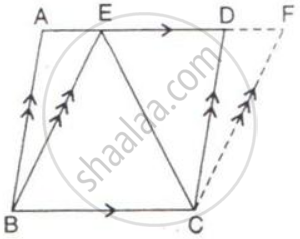
Calculate : 
(i) Area of parallelogram ABCD;
(ii) Area of the parallelogram BCFE;
(iii) Length of altitude from A on CD;
(iv) Area of triangle ECF.

Sum
Advertisements

Solution

(i) Since ΔEBC and parallelogram ABCD are on the same base BC and between the same parallels i.e. BC // AD.

∴ A( ΔEBC ) = `1/2` x A( parallelogram ABCD )

parallelogram ABCD = 2 x A( ΔEBC )
                                  = 2 x 480 cm2
                                  = 960 cm2
(ii) Parallelograms on same base and between same parallels are equal in area.
Area of BCFE = Area of ABCD = 960 cm2

(iii) Area of triangle ACD=480 = `1/2` x 30 x Altitude
Altitude = 32 cm

(iv) The area of a triangle is half that of a parallelogram on the same base and between the same parallels.
Therefore,
Area( ΔECF ) = `1/2` Area(`square`CBEF )
Similarly, Area( ΔBCE ) = `1/2`Area(`square`CBEF )

⇒ Area( ΔECF ) = Area( ΔBCE ) = 480 cm2.

shaalaa.com
Figures Between the Same Parallels
  Is there an error in this question or solution?
Chapter 16: Area Theorems [Proof and Use] - Exercise 16 (A) [Page 197]

APPEARS IN

Selina Concise Mathematics [English] Class 9 ICSE
Chapter 16 Area Theorems [Proof and Use]
Exercise 16 (A) | Q 12 | Page 197

RELATED QUESTIONS

ABCD is a trapezium with AB // DC. A line parallel to AC intersects AB at point M and BC at point N.
Prove that: area of Δ ADM = area of Δ ACN.


In the following, AC // PS // QR and PQ // DB // SR.

Prove that: Area of quadrilateral PQRS = 2 x Area of the quad. ABCD.


In the given figure, D is mid-point of side AB of ΔABC and BDEC is a parallelogram.

Prove that: Area of ABC = Area of // gm BDEC.


In parallelogram ABCD, P is a point on side AB and Q is a point on side BC.
Prove that:
(i) ΔCPD and ΔAQD are equal in the area.
(ii) Area (ΔAQD) = Area (ΔAPD) + Area (ΔCPB)


In the given figure, M and N are the mid-points of the sides DC and AB respectively of the parallelogram ABCD.

If the area of parallelogram ABCD is 48 cm2;
(i) State the area of the triangle BEC.
(ii) Name the parallelogram which is equal in area to the triangle BEC.


ABCD is a trapezium with AB parallel to DC. A line parallel to AC intersects AB at X and BC at Y.
Prove that the area of ∆ADX = area of ∆ACY.


E, F, G, and H are the midpoints of the sides of a parallelogram ABCD.
Show that the area of quadrilateral EFGH is half of the area of parallelogram ABCD.


The given figure shows a parallelogram ABCD with area 324 sq. cm. P is a point in AB such that AP: PB = 1:2
Find The area of Δ APD.


In parallelogram ABCD, E is a point in AB and DE meets diagonal AC at point F. If DF: FE = 5:3 and area of  ΔADF is 60 cm2; find
(i) area of ΔADE.
(ii) if AE: EB = 4:5, find the area of  ΔADB.
(iii) also, find the area of parallelogram ABCD.


Show that:

The ratio of the areas of two triangles of the same height is equal to the ratio of their bases.


Share
Notifications

Englishहिंदीमराठी


      Forgot password?
Use app×